

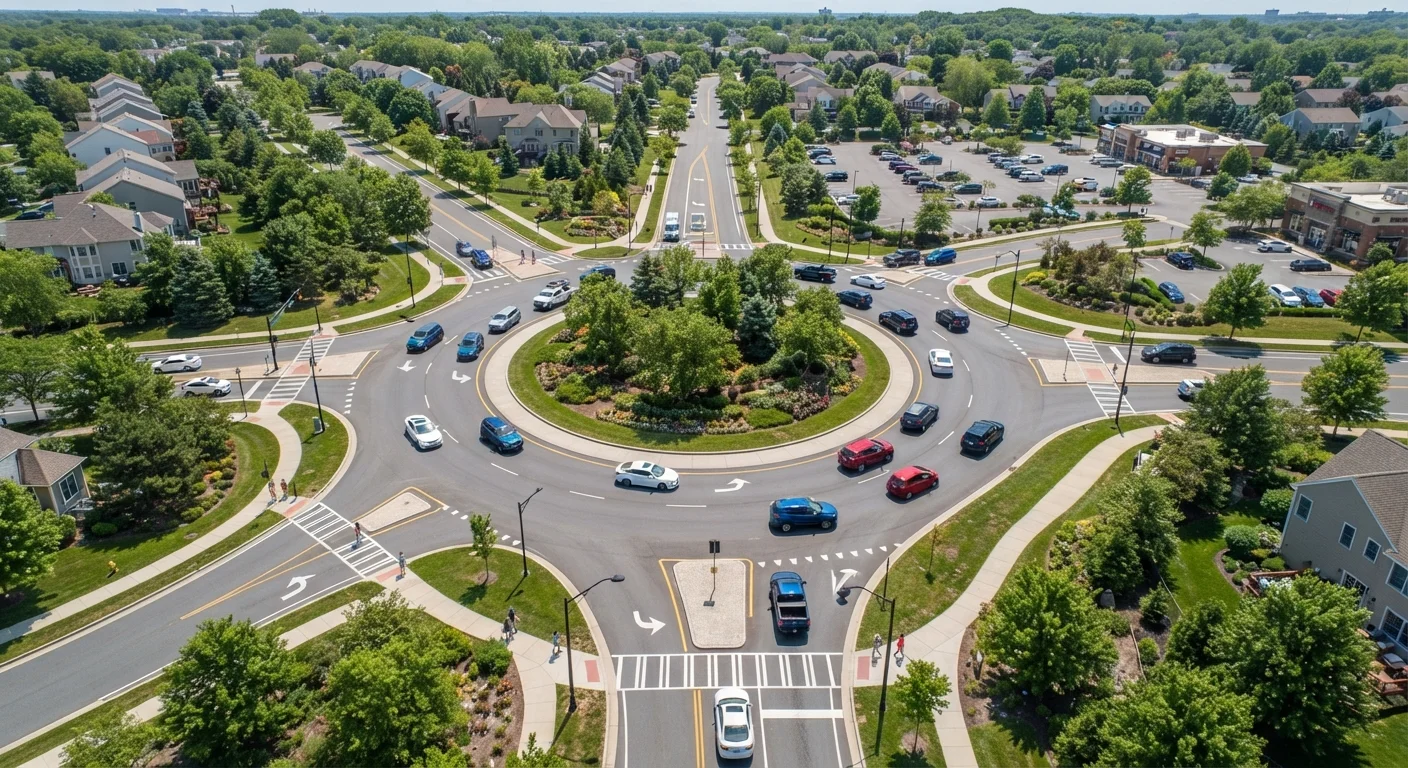
| Roundabout right-of-way | Vehicles already in the circle have priority; entering drivers must yield |
| Four-way stop primary rule | First to arrive, first to proceed |
| Four-way stop tie-breaker | Yield to the driver on your right when arrival is simultaneous |
| Yield sign requirement | Slow and be prepared to stop; only stop fully if no safe gap exists |
| Roundabout traffic direction | Counterclockwise in the United States; always look left when entering |
| Speed at 45 mph | ≈66 feet per second - gaps at yield signs close quickly |
Why These Intersections Trip Up Experienced Drivers
Most drivers learn intersection rules for a licensing exam and rarely revisit them. The result: hesitation, near-misses, and occasional collisions caused not by recklessness but by simple confusion about who goes first. Roundabouts, four-way stops, and yield signs each operate on different logic - and applying the wrong rule to the wrong intersection is a common mistake.
Understanding the underlying principles - not just the rules - helps you respond correctly even in unfamiliar situations. This reference breaks down each type clearly so you can build habits that hold up in real traffic.
| Roundabout right-of-way | Vehicles already in the circle have priority; entering drivers must yield |
| Four-way stop primary rule | First to arrive, first to proceed |
| Four-way stop tie-breaker | Yield to the driver on your right when arrival is simultaneous |
| Yield sign requirement | Slow and be prepared to stop; only stop fully if no safe gap exists |
| Roundabout traffic direction | Counterclockwise in the United States; always look left when entering |
| Speed at 45 mph | ≈66 feet per second - gaps at yield signs close quickly |
Roundabouts: Yield to Traffic Already Inside
A roundabout is a one-way circular intersection where entering vehicles must yield to vehicles already traveling within the circle. This is the single most important rule: the circle has priority, not the approach.
When you arrive at a roundabout, slow down and look left - that is the direction from which circulating traffic will approach. If the circle is clear, enter smoothly without stopping. If vehicles are already in the roundabout, wait until there is a safe gap, then merge into the flow. Never stop inside the roundabout unless an emergency requires it; this disrupts traffic behind you and increases rear-end risk.
Lane selection matters in multi-lane roundabouts. As a general rule, use the right lane for exits in the first half of the circle, and the left lane for exits further around. Check your state's driver handbook for local guidance, as lane markings vary.
Roundabouts are designed to reduce the severity of crashes compared with traditional signaled intersections, largely by eliminating high-speed right-angle collisions. However, they require active attention to gap selection - something many drivers underestimate. For more on what road design can and can't do for your safety, see common misconceptions about vehicle safety features.
Right-of-way
The legal priority to proceed through an intersection or roadway section before another driver. Right-of-way can be given or taken, but it cannot be forced - even if you have it, you must still avoid a crash.
Roundabout
A one-way circular intersection designed to keep traffic flowing without signals. Entering drivers yield to vehicles already circulating inside the ring.
All-way stop
An intersection where all approaches have stop signs, requiring every vehicle to stop before proceeding. Right-of-way is determined by order of arrival, with the right-side tie-breaker applying when vehicles arrive simultaneously.
Gap judgment
The driver skill of estimating whether there is enough space and time in oncoming traffic to safely merge, turn, or cross. Poor gap judgment is a leading factor in yield-related crashes.
Circulating traffic
Vehicles already moving within a roundabout. These drivers have priority over vehicles attempting to enter from any approach.
Four-Way Stops: Order of Arrival and the Tie-Breaker
A four-way stop (also called an all-way stop) requires every vehicle approaching from any direction to come to a complete stop. Right-of-way is then determined by a two-part rule:
- First to arrive, first to go. The vehicle that stopped first proceeds first. If you arrive at the intersection and another car is already stopped and waiting, they go before you - even if you are to their right.
- Tie goes to the driver on the right. When two or more vehicles arrive simultaneously, the driver on the left yields to the driver on the right. This is the tie-breaker only - it does not override the arrival-order rule.
A third scenario trips up many drivers: two vehicles stopped directly opposite each other. If both are going straight or turning right, both can proceed simultaneously. If one is turning left, that driver must yield to the oncoming driver going straight.
The most dangerous habit at four-way stops is waving another driver through out of sequence. This creates confusion because the waved driver may not know whether other vehicles have also been gestured forward. Proceed according to the rules, not courteous guesses. For context on how confusion at intersections connects to broader driving behavior, see the difference between assertive driving and road rage.
Yield Signs: Speed, Gap Judgment, and When to Stop
A yield sign means you must slow and be prepared to stop if necessary, giving right-of-way to cross traffic or merging traffic as indicated by the road layout. Unlike a stop sign, a yield sign does not require you to come to a complete stop - but it does require you to stop if a safe gap does not exist.
The key skill at a yield is gap judgment: reading the speed and distance of approaching vehicles accurately enough to merge or cross safely without forcing other drivers to brake. Underestimating a vehicle's speed is the most common error. A vehicle traveling at 45 mph covers roughly 66 feet per second - gaps close faster than they appear.
Yield signs appear in several contexts: highway on-ramps, roundabout approaches, pedestrian crossings, and T-intersections where a minor road meets a major one. The rule is the same in each case - approaching traffic has priority, and you must adjust your speed or stop accordingly.
Rolling through a yield without adequately checking cross traffic is a leading cause of intersection crashes. If visibility is limited, treat the yield as a stop until you can confirm the path is clear.
This article provides general driver education information. Always consult your state's official driver handbook for regulations specific to your jurisdiction, and adapt to posted signage and local traffic laws.