

Key Takeaways
Why the Right Activity Makes a Difference
Parents face real pressure to fill after-school hours productively, but not every activity earns its time slot. Research from educational psychology consistently shows that activities supporting executive function - the mental skills that govern planning, focus, and self-regulation - produce the strongest academic benefits. Executive function is essentially the engine behind homework completion, test preparation, and long-term goal-setting.
The good news: you don't need expensive programs to find high-value options. Many of the most academically reinforcing activities cost little or nothing and are available through public schools, libraries, and community organizations. If your child also navigates learning differences, pairing the right activity with targeted classroom support can be especially powerful - see our guide for families navigating learning differences for more context.
Below are eight after-school activities that research and educators consistently recognize as genuinely supportive of academic growth.
Chess or Strategy-Based Games Clubs
Chess clubs - and similar strategy games like checkers or Go - require players to think several moves ahead, manage competing priorities, and recover from setbacks. These demands map directly onto academic planning skills. A growing body of research, including studies reviewed by the U.S. Department of Education, suggests that chess instruction can support mathematical reasoning and reading comprehension, particularly in elementary and middle school students.
Many public schools and libraries run free or low-cost chess clubs. Look for programs affiliated with national nonprofits that offer structured instruction rather than informal drop-in sessions.
Chess requires exactly the forward-thinking and error-recovery skills that drive academic success.
Reading or Book Clubs
Voluntary reading is one of the most evidence-backed drivers of vocabulary growth, reading fluency, and general knowledge - all of which support performance across every subject, not just English class. A structured book club adds social accountability and the cognitive exercise of articulating and defending ideas in discussion.
Public library systems frequently offer free youth book clubs with age-appropriate titles. Schools sometimes run lunchtime or after-school reading groups as well. The key ingredient is choice: research consistently shows that when children select their own reading material, engagement and retention improve substantially.
Student-chosen reading builds vocabulary and comprehension across all subject areas, not just English.
Coding and Computational Thinking Programs
Learning to write code teaches logical sequencing, precise communication, and iterative problem-solving - skills that transfer directly to mathematics and scientific reasoning. Programs designed for K-12 learners typically use visual, block-based interfaces before introducing text-based languages, making the entry point accessible even for younger children.
Many public libraries and community centers offer free introductory coding workshops. Nonprofit organizations with a national footprint also provide structured curricula to schools at no cost. Look for programs that emphasize understanding over output: a child who learns why a loop works gains more than one who memorizes syntax.
Coding teaches logical sequencing and iterative thinking - directly transferable to math and science.
Debate or Public Speaking Programs
Debate clubs build a specific cluster of academic skills: research, argument construction, evidence evaluation, and clear written and spoken expression. Students who participate in structured debate programs regularly encounter opposing viewpoints, which strengthens critical thinking and the ability to read complex texts with purpose.
Academic debate is available through many middle and high schools at little or no cost. Some organizations also offer community-based programs for younger students. Even informal household debates about everyday topics - conducted respectfully - can begin building these habits early.
Debate builds research, critical analysis, and expressive communication - a complete academic skill set.
Maker Spaces and STEM Workshops
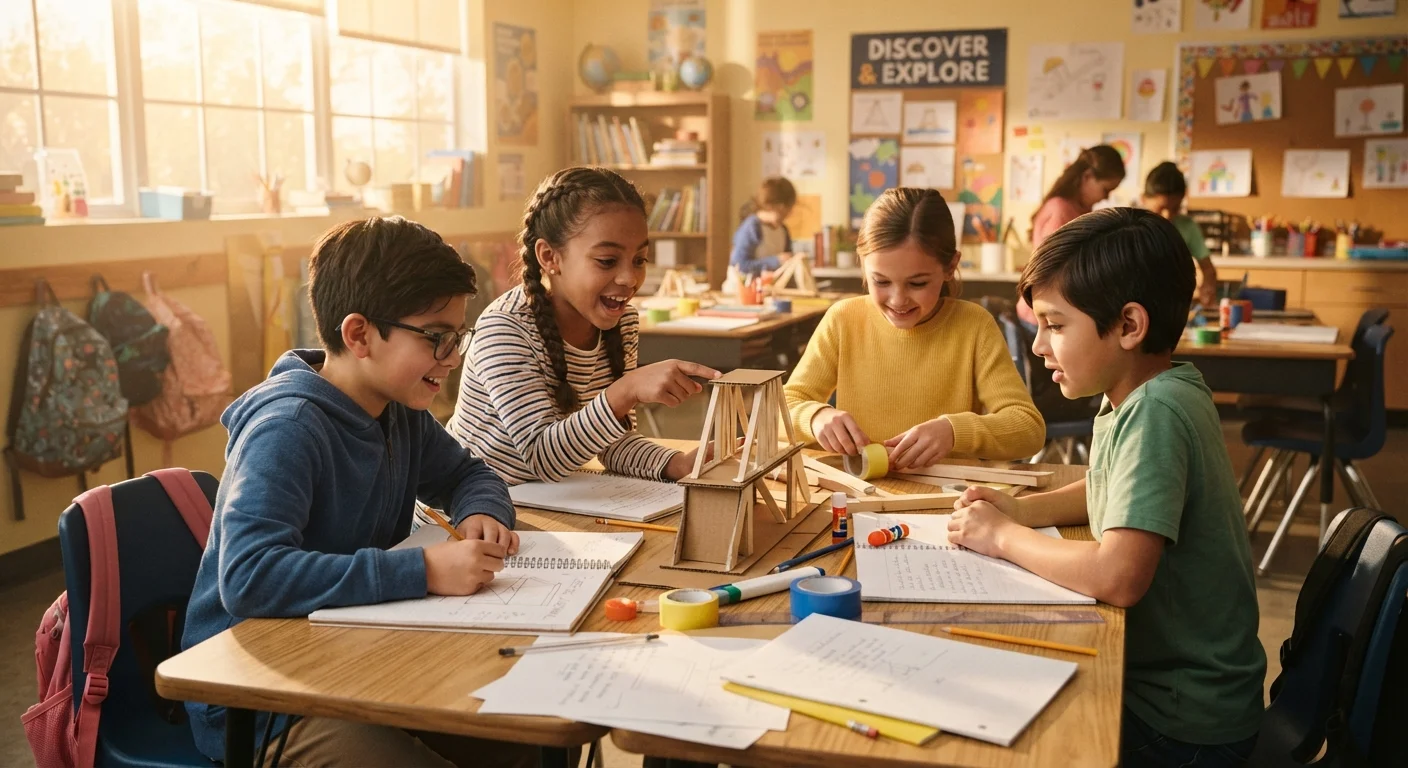
Hands-on making - building, tinkering, designing, and testing physical or digital projects - engages spatial reasoning, hypothesis testing, and creative problem-solving. These cognitive processes parallel what students do in science labs and math classes, but in a lower-stakes, intrinsically motivating environment.
Many public libraries now maintain maker spaces with materials available free of charge. Community colleges occasionally open STEM workshops to younger learners on weekends. The hallmark of a high-quality maker program is reflection: students should be encouraged to explain what worked, what didn't, and why.
Making and tinkering engage spatial reasoning and hypothesis testing in ways that reinforce classroom science.
Music Lessons or Ensemble Participation
Decades of research associate sustained music education with stronger phonological awareness (the ability to identify and manipulate sound units in language), improved working memory, and enhanced mathematical processing. These effects appear most pronounced when music instruction is consistent and skill-focused rather than purely recreational.
School band, orchestra, and choir programs are typically the most accessible and affordable pathways. Private lessons are beneficial but not required for academic transfer effects to occur - structured group participation delivers meaningful cognitive benefits on its own.
Sustained music education is linked to stronger working memory and mathematical processing in students.
Community Service and Project-Based Volunteering
Structured service projects - ones with a clear problem, planning phase, and execution - cultivate civic knowledge, empathy, and real-world application of academic content. A student who designs a community garden applies biology, math, and writing skills in an integrated, meaningful context. This kind of project-based learning outside school walls can deepen academic engagement by making abstract content feel purposeful.
School-based service learning programs often provide this structure. Local nonprofits, faith organizations, and parks departments may also offer supervised opportunities appropriate for different age groups.
Project-based service work makes abstract academic content feel purposeful - strengthening engagement and retention.
Drama and Theatrical Productions
Participation in school plays and community theater requires children to read scripts with comprehension, memorize and sequence information, collaborate under pressure, and regulate emotions during performance - a demanding combination of academic and social-emotional skills. Research in arts education suggests regular drama participation supports literacy development and perspective-taking.
School drama programs are typically low-cost or free. Community theater groups often welcome young performers, and some offer scholarship-based tuition assistance. Look for programs that include script analysis and rehearsal discipline rather than informal performance only.
Theater demands reading comprehension, memory, collaboration, and emotional regulation - all academically transferable skills.
Putting It All Together
The goal isn't to maximize the number of activities on a child's calendar - it's to choose deliberately. One or two activities that build transferable skills, foster genuine interest, and fit within your family's time and budget will outperform a packed schedule that leaves a child drained. If schedule pressure is already a concern, the strategies in our article on building study habits that carry students through high school can help you prioritize what matters most.
Start With One Activity, Not Five
A common mistake is enrolling children in multiple activities simultaneously to maximize exposure. In practice, depth beats breadth: a child who commits consistently to one meaningful activity develops stronger habits, greater skill, and more genuine engagement than one stretched across several obligations. If budget is a factor, focus resources on the single activity your child is most intrinsically motivated to pursue.
For families thinking further ahead, extracurricular choices in middle and high school can also play a role in college planning. Our overview of extracurriculars that strengthen a college application explains what depth and consistency look like from an admissions perspective - a useful frame even for younger students just getting started.
This article provides general educational information. Every child's needs and circumstances differ; consider consulting a school counselor or educator when making decisions about your child's specific academic support plan.