

Key Takeaways
Our Verdict
Envelope budgeting delivers immediate, tactile spending control that works especially well for households prone to overspending in variable categories. Spreadsheet budgeting suits those who prefer data visibility, handle irregular income, or want detailed historical tracking. Both can be effective - the deciding factor is which system you'll actually maintain month after month.
| Best for | Recommended |
|---|---|
| Families who overspend on groceries, dining, or discretionary categories | Envelope Budgeting |
| Households with variable or freelance income needing flexible tracking | Spreadsheet Budgeting |
| Budgeters who are new to managing money and want simple guardrails | Envelope Budgeting |
| Families tracking multiple savings goals and long-term financial trends | Spreadsheet Budgeting |
What Each Method Actually Involves
Both approaches aim at the same target - spending less than you earn and directing money with intention - but they get there differently. Understanding each method on its own terms helps you make a fair comparison.
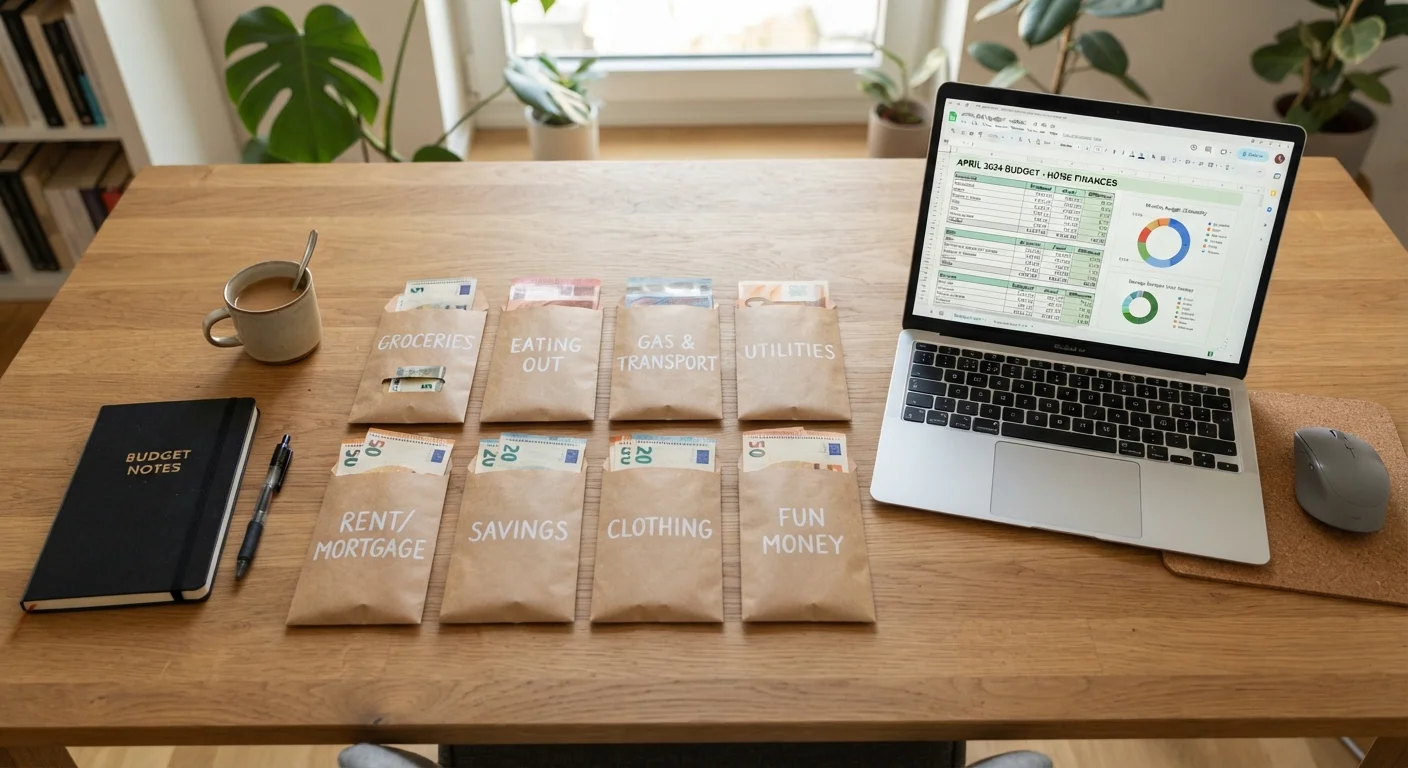
Envelope budgeting is a cash-based system. At the start of each pay period, you withdraw your spending money and physically divide it into labeled envelopes: one for groceries, one for gas, one for dining out, and so on. When an envelope is empty, spending in that category stops. No transfers, no exceptions. The friction is the point.
Spreadsheet budgeting keeps everything digital. You set income and category limits in a table - built in a program like Google Sheets or Excel - then log every transaction as it happens. Your running totals show exactly where you stand at any moment. Unlike envelopes, there's no physical barrier stopping you from overspending, so the system relies on your willingness to check in regularly and respond to what you see.
For a grounded refresher on the vocabulary both methods share, see our plain-language budgeting glossary.
How the Two Methods Compare
Below is a direct comparison across the criteria that matter most for everyday family budgets.
| Envelope Budgeting | Spreadsheet Budgeting | |
|---|---|---|
| Core mechanism | Physical cash divided by category | Digital income and expense tracking |
| Spending enforcement | Hard stop when envelope is empty | Self-enforced via regular review |
| Setup time | Minimal - label envelopes, withdraw cash | Moderate - build or adapt a template |
| Works for online purchases | Poorly - cash doesn't translate easily | Yes - any transaction can be logged |
| Handles variable income | Awkward - requires full restructure | Easy - update figures each month |
| Historical reporting | None - no paper trail retained | Strong - data accumulates over time |
| Best habit type | Visual, tangible, impulsive spenders | Detail-oriented, consistent loggers |
One note on security: carrying large amounts of cash does carry some risk of loss or theft - something digital systems avoid. Spreadsheets, however, can feel abstract enough that spending limits get ignored without strong personal discipline.
Where Each Method Tends to Struggle
No budgeting system is frictionless. Knowing the common failure points helps you shore them up before they sink you.
Envelope pitfalls: The system breaks down when people borrow between envelopes - taking from "dining" to cover a grocery shortfall - without accounting for the shift. It also becomes cumbersome with online purchases and automatic bill payments, which don't lend themselves to physical cash. Most families using envelopes limit the system to variable, discretionary categories and pay fixed bills - mortgage, utilities, insurance - by check or autopay.
Spreadsheet pitfalls: The most common failure is delayed logging. If you record purchases once a week rather than in real time, you lose the feedback loop that makes the system useful. Spreadsheets also require an upfront time investment to build and can feel overwhelming to maintain for families new to budgeting.
Try a One-Month Test Before Committing
Rather than debating which method is theoretically better, run one for a single month with real numbers. Use your actual income, your real spending categories, and track honestly. One month of lived experience reveals fit faster than any checklist. If neither feels sustainable alone, a hybrid approach may be the answer.
Both methods handle fixed and variable expenses differently. Envelopes are strongest on variable spending; spreadsheets can handle all expense types in one place.
Which Approach Fits Your Household
A few honest questions point most families toward their better match:
- Do you regularly overspend in specific categories like groceries or dining? Envelopes create a physical stop that willpower alone often can't. The visibility of dwindling cash changes behavior in the moment.
- Is your income variable or irregular? Spreadsheets adapt more easily when monthly take-home pay shifts - you can update figures without rebuilding a physical system from scratch.
- Are you tracking toward specific savings goals? Spreadsheets let you model multiple goals simultaneously and chart progress over time. They also integrate naturally with savings and debt payoff planning.
- Do you shop heavily online? A pure cash envelope system creates friction with card-based and online purchases. You'd need to supplement it with a digital tracker or limit envelopes to in-person spending only.
Some households run a hybrid: cash envelopes for the two or three categories where they historically overspend, and a simple spreadsheet for everything else. That combination can capture the behavioral control of cash with the flexibility of digital tracking.
Whatever you choose, don't overlook irregular costs - car registration, school fees, annual subscriptions - that fall outside a typical monthly budget. Our guide on spending categories families often forget is worth reviewing before you finalize your category list.
This article is part of our complete family budgeting guide, which covers methods, tools, and long-term habits in one place.
This article is for general informational and educational purposes only and does not constitute personalized financial advice. Consult a qualified financial professional for guidance specific to your situation.