

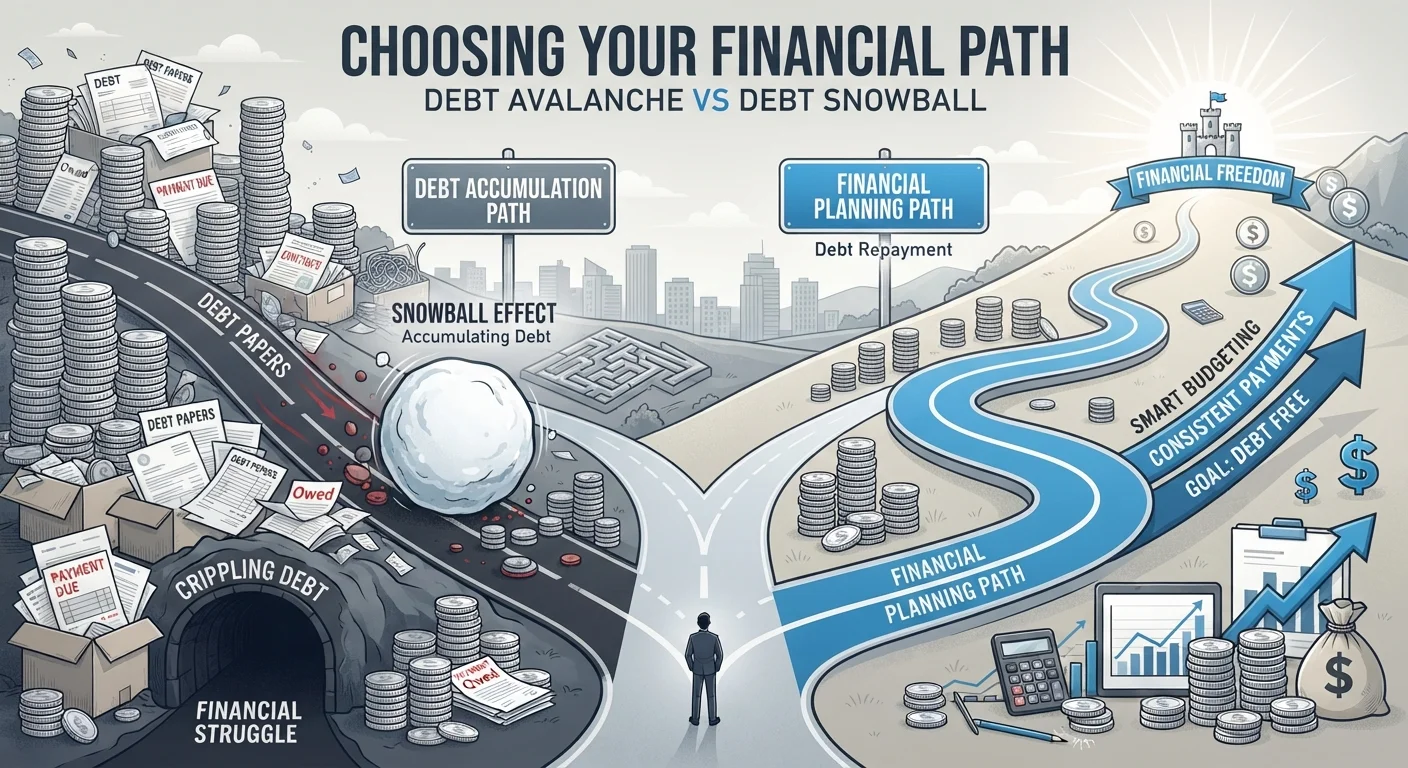
Key Takeaways
Option A
Debt Avalanche
The mathematically optimal, interest-minimizing approach.
Best for: Families who are disciplined, motivated by long-term savings, and comfortable delaying early wins.
Option B
Debt Snowball
The behaviorally powerful, momentum-driven approach.
Best for: Families who need quick motivational wins to stay committed and build lasting payoff habits.
If you're motivated by saving maximum interest over time
Debt Avalanche
Targeting your highest interest rate first reduces the total amount you pay before becoming debt-free, often by hundreds or thousands of dollars.
If you've struggled to stick with a debt plan in the past
Debt Snowball
Eliminating smaller balances quickly creates genuine momentum and a proven psychological reward loop that keeps families engaged long-term.
If your debts carry similar interest rates
Debt Snowball
When rates are close, the interest savings from the avalanche method are minimal, so the motivation boost from quick wins makes the snowball a smarter practical choice.
If you have one or two very high-rate debts dominating your budget
Debt Avalanche
A single high-interest debt - such as a store card above 25% APR - can cost more than all other debts combined; eliminating it first frees up significant cash flow.
If you're just starting your debt payoff journey
Debt Snowball
Early success matters: closing out even a small balance gives new proof that your plan is working and reduces the psychological weight of owing money.
The Core Difference Between These Two Methods
Both the debt avalanche and debt snowball share the same mechanical foundation: you make minimum payments on every debt, then direct every additional dollar toward one target debt at a time. The only difference is which debt you target first.
With the debt avalanche, you rank debts by interest rate and attack the highest rate first. Once that's gone, you roll its payment into the next highest, and so on. The logic is purely mathematical - high-rate debt grows faster, so eliminating it first stops the most expensive bleeding.
With the debt snowball, popularized by personal finance educator Dave Ramsey, you rank debts by balance from smallest to largest and pay off the smallest first. Interest rates are irrelevant to the ordering. The logic is behavioral - paying off an entire debt account feels like a real win, even if that account cost you less in interest than a larger one would have.
If you're new to structured debt payoff, see our starter's handbook to getting out of debt for the foundational concepts before choosing a method.
| Criterion | Debt Avalanche | Debt Snowball |
|---|---|---|
| Payoff order | Highest interest rate first | Smallest balance first |
| Total interest paid | Lower - mathematically optimal | Higher - rates deprioritized |
| Time to first win | Longer - may take months or years | Shorter - small balances close fast |
| Motivation style | Abstract (dollar savings) | Concrete (account closures) |
| Best for | Disciplined, analytical households | Households needing momentum |
| Works best when | High-rate debt dominates the profile | Multiple small debts clutter the budget |
| Risk of quitting | Higher if progress feels invisible | Lower due to early positive feedback |
What the Numbers Actually Show
On paper, the avalanche wins every time. Consider a family with three debts: a $6,000 credit card at 22% APR, a $2,500 medical bill at 0% interest, and a $4,000 personal loan at 11%. A strict avalanche approach targets the credit card first. A snowball approach targets the medical bill first.
By paying off the zero-interest medical bill first, the snowball strategy doesn't save money - it actually costs more in total interest because the 22% card continues compounding longer. For most debt profiles, the avalanche saves a meaningful amount in interest, sometimes several hundred to over a thousand dollars depending on balances and rates.
22%+
Typical high-end credit card APR in the US
According to the Federal Reserve, average credit card interest rates have exceeded 20% APR in recent years, making high-rate debt the most urgent target for many families.
$6,000+
Average US household credit card balance
Federal Reserve data consistently shows American households carry thousands in revolving credit card debt, making payoff strategy selection consequential.
Higher consistency
Snowball users' likelihood of eliminating debt
A 2016 Journal of Marketing Research study found that focusing on paying off individual accounts - rather than optimizing mathematically - improved actual debt elimination rates.
However, the numbers only hold if you stick with the plan. A 2016 study published in the Journal of Marketing Research found that consumers who focused on eliminating individual accounts - the snowball approach - were more likely to eliminate their overall debt than those spreading payments proportionally. Consistency outperforms optimization when willpower is limited.
For families also juggling savings goals, our article on paying off debt vs. saving money offers a clear framework for prioritizing when you can't do both at once.
Choosing the Right Method for Your Household
The honest answer: the best strategy is the one you'll actually maintain for 12, 24, or 36 months. Here's how to think through which fits your household.
Choose the avalanche if:
- You have one or more debts with rates above 20% - the interest savings are too large to ignore.
- You're comfortable tracking progress in dollars saved, not accounts closed.
- Your debts are similar in balance size, so the snowball wouldn't produce noticeably faster early wins anyway.
Choose the snowball if:
- You've tried a debt plan before and quit - you need behavioral reinforcement.
- You have several small balances cluttering your budget; eliminating them simplifies monthly cash flow fast.
- Seeing a $0 balance is more motivating to you than seeing an interest savings projection.
Some families use a hybrid approach: clear one or two small nuisance balances first (a snowball-style opener), then switch to avalanche order for remaining debts. This isn't textbook either method, but it can work well in practice.
Our debt-free roadmap for families walks through how to organize your debts and structure a complete payoff plan from first payment to final balance.
If you find your plan stalling despite good intentions, signs your debt repayment plan isn't working can help you identify and fix what's going wrong before you lose momentum.
This article is for general informational and educational purposes only and does not constitute personalized financial advice. Consult a licensed financial professional before making decisions about your specific debt repayment situation.