

Key Takeaways
Why the Nutrition Facts Panel Exists
The Nutrition Facts label is a federally standardized tool regulated by the U.S. Food and Drug Administration (FDA). Its current format - updated in 2020 - was redesigned to reflect what nutrition science has learned about diet and chronic disease. For families making dozens of food decisions each week, understanding this panel is one of the most practical nutrition skills available.
The label does not tell you whether a food is good or bad. It gives you data you can compare and contextualize within your family's overall eating pattern. Pair this skill with broader food literacy - for example, understanding what distinguishes whole grains from refined grains - and the numbers on any package become far more meaningful.
If some of the terms below feel unfamiliar, the Family Nutrition Vocabulary Cheat Sheet is a useful reference to keep handy.
How to Read Each Section of the Label
Start With the Serving Size
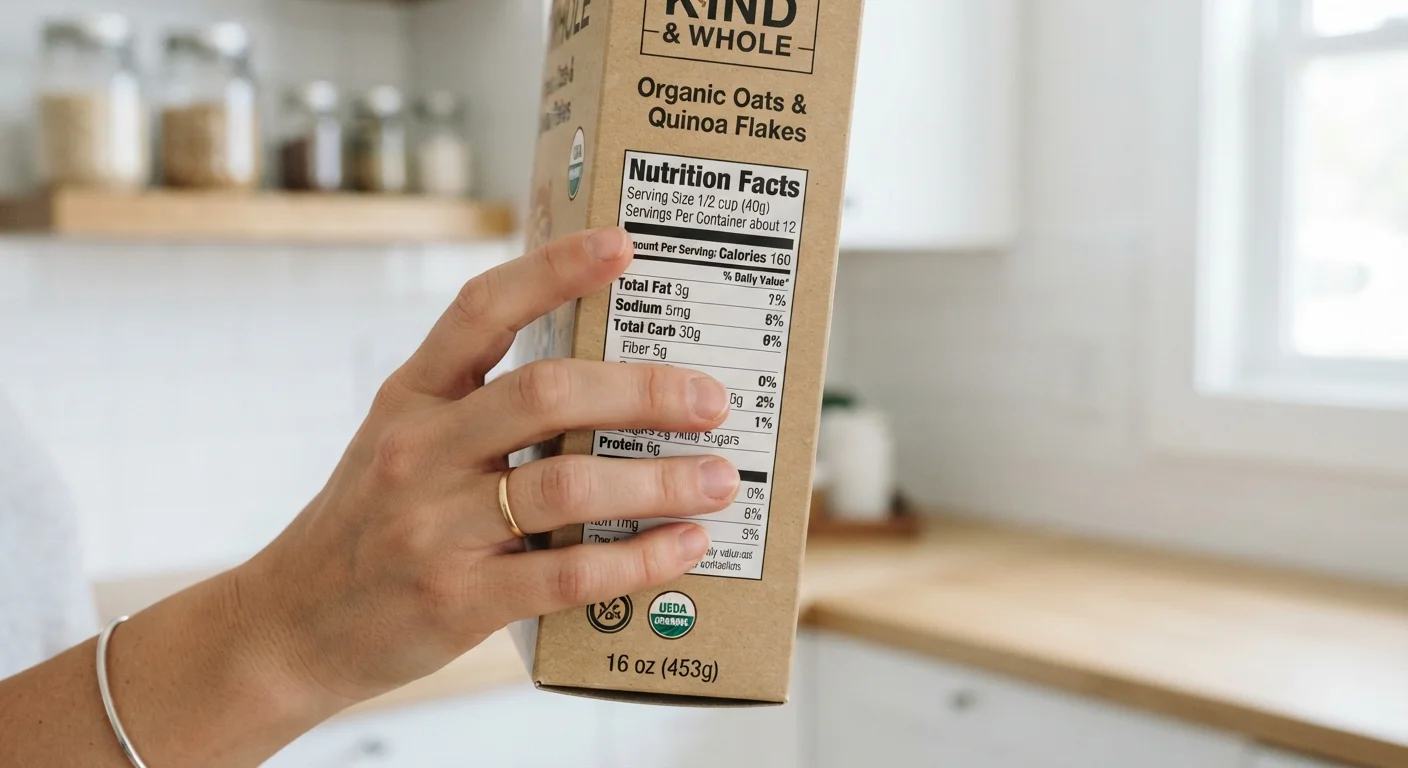
The very first line under "Nutrition Facts" lists the serving size and the number of servings per container. Every number on the rest of the label - calories, fat, sodium, vitamins - applies to that one serving, not the whole package.
If a box of crackers lists a serving as 15 crackers and you eat 30, you're consuming double every value shown. Check this line before anything else.
Check the Calories
Calories measure the total energy a serving provides. The updated label displays calories in a larger, bolder font than older versions, making this easier to spot. Calories alone don't determine a food's nutritional value - a food can be calorie-dense and nutrient-rich, or calorie-dense and nutrient-poor - so continue reading before drawing conclusions.
Use % Daily Value as Your Quick Guide
The % Daily Value (%DV) column shows how much of a nutrient one serving contributes toward a general daily intake reference (based on a 2,000-calorie diet). The FDA's practical rule of thumb: 5% DV or less is low; 20% DV or more is high.
- For nutrients you want to limit - saturated fat, sodium, added sugars - look for low %DV values.
- For nutrients you want to get enough of - dietary fiber, vitamin D, calcium, iron, potassium - look for higher %DV values.
This column is the fastest way to compare two similar products side by side without doing any math.
Identify Nutrients to Limit
Current dietary guidance from the 2020-2025 Dietary Guidelines for Americans identifies these nutrients as ones most Americans consume in excess:
- Saturated fat: Associated with cardiovascular risk when consumed in large amounts over time. Aim for low %DV.
- Sodium: Most packaged and processed foods contribute significant sodium. Comparing %DV across brands is one of the simplest ways to reduce intake without changing what you eat.
- Added sugars: The updated label now distinguishes added sugars from naturally occurring sugars. The Dietary Guidelines recommend limiting added sugars to less than 10% of daily calories.
Prioritize Nutrients to Seek Out
These nutrients appear on the label because many Americans fall short of recommended amounts:
- Dietary fiber: Supports digestive health and is associated with reduced chronic disease risk. Most Americans consume well below recommended amounts.
- Vitamin D and calcium: Important for bone health across all ages, including growing children.
- Iron: Especially relevant for young children, adolescent girls, and people who are pregnant.
- Potassium: Associated with healthy blood pressure; often underconsumed in typical American diets.
Choosing products with higher %DV for these nutrients is a straightforward way to improve dietary quality without dramatically changing your grocery list. Foods that are genuinely rich in diverse nutrients often align with advice like eating the rainbow.
Read the Ingredient List
Ingredients are listed in descending order by weight - the first ingredient makes up the largest portion of the product. A long ingredient list isn't automatically problematic, but certain patterns are worth noting:
- If sugar (or one of its many alternate names - high-fructose corn syrup, dextrose, cane juice, maltose) appears among the first three ingredients, added sugar is a dominant component.
- Whole grain should be listed as the first grain ingredient (e.g., "whole wheat flour") for a product to be meaningfully whole-grain based.
- The presence of partially hydrogenated oils indicates artificial trans fat, even if the label reads 0 g per serving.
Understanding ingredient lists is closely related to recognizing how ultra-processed foods are classified - a framework increasingly used in nutrition research.
Comparing Products? Use %DV, Not Grams
When choosing between two cereals, breads, or snacks, align them by the same serving size and compare %DV columns directly. This approach removes the need to know whether 480 mg of sodium is a lot - 21% DV tells you clearly that it is. It also works when a store brand and a name brand have slightly different serving sizes.
Once you're comfortable decoding labels, you can apply that skill to broader shopping strategies. See our realistic nutrition roadmap for families on a grocery budget for practical ways to put label knowledge to work at the store.
Common Label Traps and How to Avoid Them
Even careful readers can be misled by how food information is presented. Here are the most common sources of confusion:
- Front-of-package claims: Words like "natural," "multigrain," "light," or "made with whole grain" are largely marketing terms. They are not substitutes for reading the actual Nutrition Facts panel and ingredient list. The FDA regulates some claims (such as "low sodium" or "good source of fiber"), but many others carry no strict legal definition.
- Misleading serving sizes: A small bag of chips or a bottled drink may list a serving size that represents only half the container - even though most people consume the whole thing. Always check how many servings are in the package before evaluating the numbers.
- "0 g trans fat" with partially hydrogenated oil in ingredients: FDA rules allow a product to claim 0 g trans fat if it contains less than 0.5 g per serving. If partially hydrogenated oils appear in the ingredient list, trace amounts may still be present.
Understanding these patterns is especially helpful when common grocery habits quietly work against your nutrition goals. Even well-intentioned shoppers can be steered by packaging language that doesn't reflect a food's full nutritional picture.
Labels Reflect One Serving - Not the Package
A single-serve-looking bottle of juice or a snack bag may contain two or more servings according to the label. Consuming the entire container means multiplying every nutrient figure by the number of servings listed. This is one of the most common - and consequential - misreads of the Nutrition Facts panel.
This article provides general nutrition education and is not a substitute for personalized dietary advice. Consult a registered dietitian or your family's healthcare provider for guidance specific to your household's health needs.