

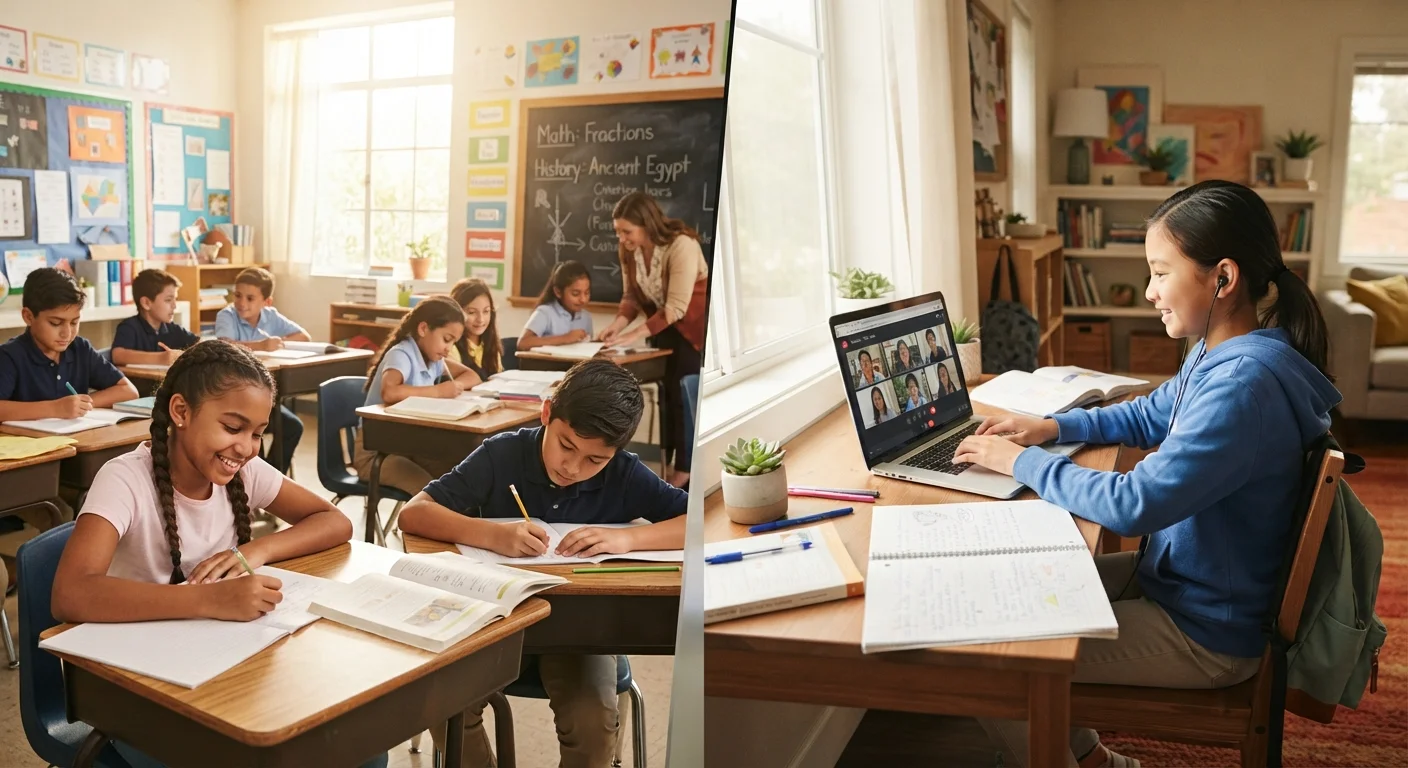
Key Takeaways
Option A
In-Person School
The structured, socially rich traditional option.
Best for: Children who thrive with routine, face-to-face interaction, and hands-on classroom activities.
Option B
Online School (K-12)
The flexible, self-directed alternative.
Best for: Students who need schedule flexibility, have medical needs, or learn better in a low-distraction home environment.
If your child is in early elementary grades (K-3)
In-Person School
Young children develop foundational literacy, numeracy, and social skills through in-person interaction. Research from the National Center for Education Statistics points to stronger early-grade outcomes in structured classroom settings.
If your child has a chronic illness, anxiety, or significant social challenges
Online School (K-12)
Online schooling removes physical and social barriers that can interfere with learning, allowing the student to work at a sustainable pace in a comfortable environment.
If your family values extracurriculars, sports, and peer friendships
In-Person School
Traditional schools bundle academics with clubs, athletics, and daily peer contact - social capital that is harder to build through a screen.
If your child is a self-motivated middle or high schooler with scheduling needs
Online School (K-12)
Older, independent learners can leverage online school's flexibility for pursuits like competitive athletics, performing arts, or part-time work without falling behind academically.
If you are uncertain and want to try before committing
In-Person School
In-person school remains the default with established support networks. Transitioning to online school later is generally straightforward, while returning from online to in-person can require additional academic re-alignment.
How Each Model Actually Works
In-person school places students in a physical building, following a fixed daily schedule set by a school district or charter operator. Teachers deliver instruction in real time, assessments happen on-site, and students interact with peers throughout the day. For a broader look at how the U.S. system is organized, see our K-12 parent orientation guide.
Full-time online K-12 schools - sometimes called virtual schools or cyber schools - operate differently. Many are publicly funded through a state's charter school system, meaning eligible families pay no tuition. Students receive instruction through a learning management system, attend live video lessons, and complete coursework asynchronously. A parent or guardian typically serves as a learning coach, providing daily supervision especially for younger children.
It is important to distinguish full-time online schools from homeschooling. Online public schools are accredited, follow state standards, and employ licensed teachers. They issue diplomas and transcripts just as traditional schools do. For families wondering how different public school structures compare, our breakdown of public, charter, and magnet schools adds useful context.
| Criterion | In-Person School | Online School (K-12) |
|---|---|---|
| Daily structure | Fixed bell schedule | Flexible, self-paced options |
| Social interaction | Daily, in-person peer contact | Limited; requires active supplementing |
| Tuition cost | Free (public) or tuition-based (private) | Often free via public virtual charter |
| Parent time commitment | Lower daily involvement | High - learning coach role required |
| Special education services | On-site IEP/504 support | Varies widely by state and school |
| Technology needs | Minimal home tech required | Reliable internet and device essential |
| Extracurricular access | Built-in sports, clubs, arts | Must seek community alternatives |
| Best grade range fit | All grades, especially K-5 | Middle and high school most effective |
Academic Outcomes: What the Research Shows
The evidence on academic performance generally favors in-person schooling, particularly for younger students. Studies conducted by the RAND Corporation and analyses from the National Bureau of Economic Research have found that full-time virtual school students, on average, show lower gains in math and reading compared to their in-person peers - though results vary widely by school quality and student population.
That said, outcomes in online settings improve considerably when students are older, self-directed, and have active adult involvement at home. High schoolers with strong organizational skills often perform on par with in-person peers.
~3.3M
U.S. students enrolled in virtual schools
The National Center for Education Statistics reported approximately 3.3 million students participating in fully online schools in recent enrollment surveys.
~30%
Lower math proficiency in full-time virtual settings
RAND Corporation research found full-time virtual school students showed notably lower math proficiency gains compared to similar in-person peers, on average.
50 states
States with at least one online public school option
According to the National Alliance for Public Charter Schools, every U.S. state has some form of publicly funded online schooling available to eligible K-12 students.
Children with learning differences require especially careful consideration. Online environments can offer valuable flexibility, but they may lack the specialized in-person support services - such as pull-out resource rooms or speech therapy - that a traditional school provides under an Individualized Education Program (IEP). Families navigating this should review our guide to supporting children with learning differences before deciding.
Social Development and Emotional Well-Being
One of the most frequently cited concerns about online school is the reduction in peer interaction. Daily in-person contact builds communication skills, conflict resolution, and the kind of informal social learning that happens in hallways and at lunch tables - not just in structured class time.
Online schools attempt to address this through virtual clubs, co-op learning days, and community field trips, but these supplements are generally less frequent and require more parental coordination. Families should honestly assess whether their child already has robust social outlets - through sports leagues, religious communities, or neighborhood friendships - before assuming online school will leave them isolated.
Conversely, some students experience in-person school as a source of chronic stress - due to bullying, social anxiety, or sensory sensitivities. For these children, the relative calm of a home environment can actually support better emotional regulation and, in turn, better learning. Research on how children actually learn reinforces that context and emotional safety are meaningful factors in academic engagement.
Online School Is Not Homeschooling
Full-time online public schools are state-accredited institutions with licensed teachers, standardized curricula, and official transcripts. Homeschooling, by contrast, places full instructional responsibility on parents and operates under different legal frameworks that vary by state. If you are considering homeschooling specifically, that decision involves a distinct set of legal requirements and curriculum choices not covered here.
Practical and Financial Considerations
For families weighing cost, publicly funded online charter schools typically charge no tuition and may supply a computer and internet subsidy. However, parents who must reduce work hours to serve as a learning coach face an indirect financial cost that is easy to overlook. Factor this into your household budget honestly - our family budgeting resources can help you model the impact.
In-person school also comes with costs: transportation, school supplies, activity fees, and before- or after-care programs. Neither option is entirely free in practice.
College-bound students should note that both pathways can lead to higher education. Online high school graduates are eligible to apply to colleges and qualify for federal financial aid. However, admissions offices may look closely at course rigor and extracurricular involvement, areas where in-person schools often have a structural advantage. For planning purposes, explore our college prep hub to understand what selective programs typically look for.