

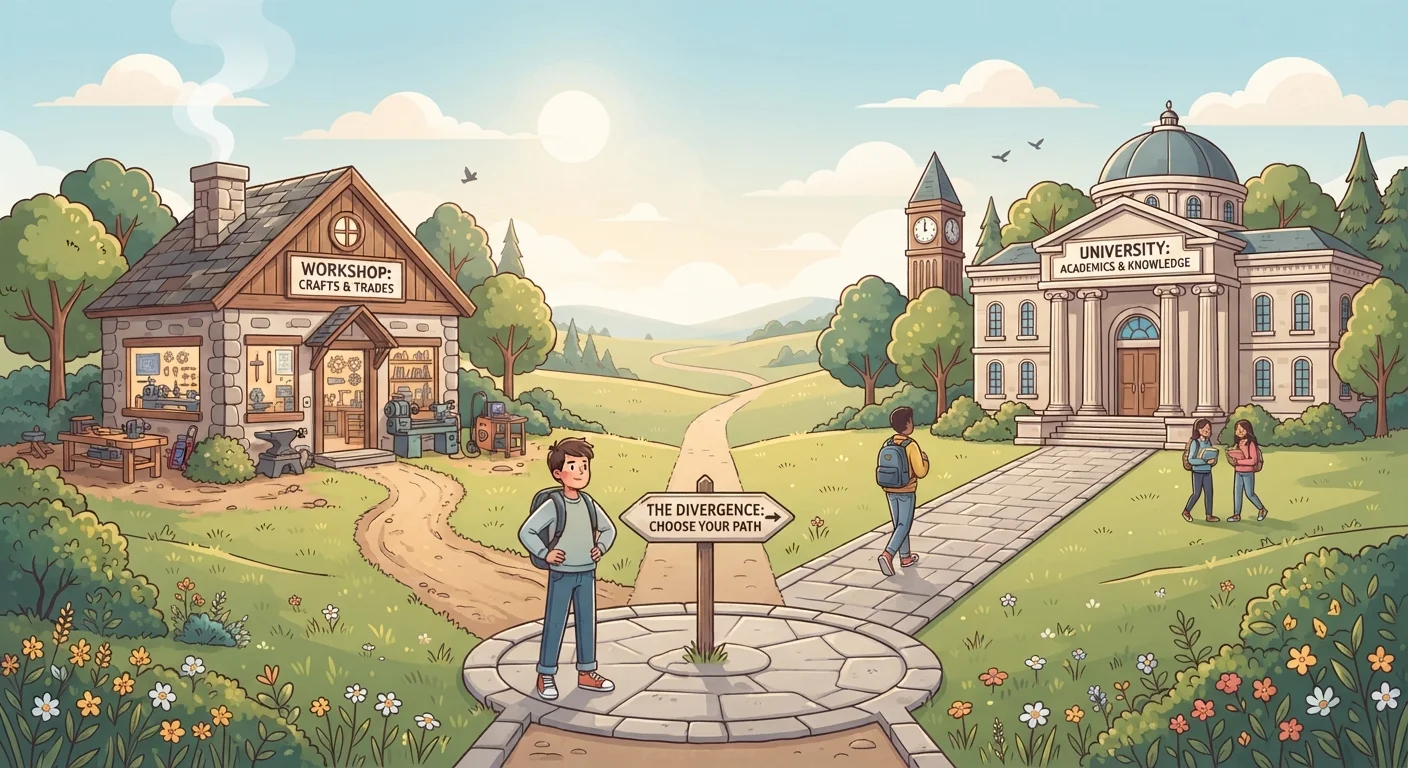
Key Takeaways
Option A
Vocational Training
The faster, skills-first route to a new career.
Best for: Adults who need job-ready skills quickly and prefer hands-on, practical learning over classroom theory.
Option B
Academic Degrees
The credential-heavy path with broader long-term positioning.
Best for: Career changers targeting fields where a bachelor's or graduate degree is a firm hiring requirement.
If you need to start earning in your new field within a year
Vocational Training
Most vocational and certificate programs run three months to two years, so you can enter the workforce and rebuild income faster than a degree allows.
If your target role legally requires a licensed degree (nursing, engineering, law, teaching)
Academic Degrees
Certain licensed professions mandate specific degrees for state licensure; no amount of practical training substitutes for that credential.
If cost and family obligations are your biggest constraints
Vocational Training
Lower tuition, shorter timelines, and evening or hybrid scheduling make vocational programs more manageable for working adults with dependents.
If you want long-term advancement into management or leadership roles
Academic Degrees
Many organizations use degree requirements as a filter for senior positions, and a degree can remain a durable asset across multiple career shifts.
If you are targeting the skilled trades, healthcare support, or technology fields
Vocational Training
Employers in these sectors commonly prioritize demonstrated competency and industry certifications over traditional academic credentials.
What Each Path Actually Looks Like
Vocational training - sometimes called career and technical education (CTE) - delivers focused, skill-specific instruction aligned to a particular occupation. Programs are offered through community colleges, trade schools, workforce development centers, and some online platforms. Typical completion times range from a few months to two years, and graduates often earn an industry certificate or certification rather than a diploma. Examples include medical coding, HVAC technician training, welding, dental assisting, and IT support.
Academic degree programs (associate, bachelor's, or graduate level) emphasize a broader curriculum that combines major-specific coursework with general education requirements. They are offered at community colleges, four-year universities, and accredited online institutions. Completion takes two years for an associate degree and four or more for a bachelor's. Some graduate programs add another one to three years on top of that.
Understanding the difference between a certificate, a certification, and a degree matters more than most people realize. See our breakdown of what each credential actually signals to employers before deciding which to pursue.
Time, Cost, and Daily Life Realities
For adults already managing jobs, childcare, or other responsibilities, time is often the deciding factor. Vocational programs are structured around working adults - many offer evening, weekend, or hybrid formats. A phlebotomy certificate, for example, may take as little as 16 weeks. An electrician apprenticeship runs four to five years but pays a wage while you learn.
Degree programs demand sustained commitment. Even part-time enrollment stretches a two-year associate degree to three or four years. That prolonged timeline has real financial and personal costs beyond tuition: foregone income, childcare, transportation, and the mental load of balancing study with adult obligations.
| Criterion | Vocational Training | Academic Degrees |
|---|---|---|
| Typical completion time | 3 months - 2 years | 2 - 4+ years |
| Average cost range | Lower; often under $10,000 | Higher; varies widely by institution |
| Credential earned | Certificate or industry certification | Associate, bachelor's, or graduate degree |
| Schedule flexibility | Often evening or hybrid formats | Varies; part-time options available |
| Employer recognition | Strong in trades, tech, healthcare support | Required for licensed professions and management |
| Transferable across fields | Narrower; role-specific skills | Broader; general and specialized knowledge |
| Financial aid eligibility | Varies; Pell Grants may apply | Full federal aid eligibility at accredited schools |
On the cost side, the gap is significant. According to the National Center for Education Statistics, the average annual tuition at public two-year colleges is far lower than at four-year institutions, and most vocational programs fall below even that benchmark. That said, financial aid, Pell Grants, and employer tuition assistance programs may apply to either path. Some states also fund workforce training grants specifically for adult career changers. Before assuming a degree is out of reach financially, review what aid is available - our guide on going back to school as an adult walks through those realities honestly.
How Employers Actually View Each Credential
Employer expectations vary sharply by industry. In skilled trades, healthcare support roles, and many technology positions, a relevant certification or vocational credential carries substantial weight - sometimes more than a general degree. An employer hiring a network technician, for instance, may prioritize a CompTIA certification over a humanities degree.
In contrast, fields like social work, accounting, nursing, and education have degree requirements embedded in their licensing frameworks. No vocational certificate replaces a required bachelor's or master's in those cases. Researching the actual job postings in your target field - not assumptions about prestige - is the most reliable way to determine what hiring managers expect.
Accreditation Matters for Both Paths
Whether you choose a vocational program or a degree, accreditation is a critical checkpoint. For degrees, regional accreditation is the standard recognized by employers and other colleges. For vocational programs, look for industry-recognized accrediting bodies relevant to your field (such as ACCSC for career schools). Programs without recognized accreditation may not qualify for federal financial aid and could be disregarded by employers. Always verify accreditation status through the U.S. Department of Education's database before enrolling.
It's also worth knowing that some employers offer tuition reimbursement for degree programs but not for vocational training, while others do the reverse. Checking your current or prospective employer's education benefits policy before enrolling can meaningfully change your out-of-pocket cost calculation. For a structured way to evaluate any program before committing, see the questions worth answering before you enroll.
Making the Decision That Fits Your Situation
Neither path is universally superior - the right choice depends on your target occupation, timeline, budget, and personal learning style. Start by identifying three to five job titles you are realistically pursuing, then research their typical hiring requirements. If postings consistently list a degree as required, that settles it. If they list certifications or experience, vocational training likely gets you there faster and cheaper.
Consider also whether you want a single-step transition or a staged one. Some career changers begin with a vocational credential to enter a new field quickly, then pursue a degree part-time once they are employed and their employer may help cover costs. This sequenced approach can reduce financial risk considerably. Our practical starting point for lifelong learning on a budget outlines low-cost first steps for adults at any income level, and is a useful companion as you plan your route forward.
This article provides general educational information and is not a substitute for personalized academic, financial, or career counseling. Readers are encouraged to consult with a licensed career counselor, academic advisor, or financial aid office for guidance specific to their circumstances.