

| Primary communication mode | Body language (posture, tail, ears, eyes) |
| Slow blink meaning | Relaxed, trusting, non-threatening |
| Belly exposure | Sign of trust - not always an invitation to touch |
| Puffed tail signal | Fear or extreme agitation |
| High, upright tail meaning | Confidence and friendly greeting |
| Ears pinned flat back | Aggression or intense fear - do not handle |
Why Cat Body Language Matters
Cats communicate almost entirely through body language - subtle shifts in ear position, tail carriage, and eye contact that many owners overlook or misread. Understanding these signals isn't just interesting; it's practical. It helps you respond appropriately to your cat's emotional state, avoid accidental stress, and catch early signs of discomfort before they escalate.
Unlike dogs, cats rarely signal distress loudly. A cat that suddenly bites during petting isn't being unpredictable - it almost certainly gave several quieter warnings first. Recognizing those warnings is the foundation of a calmer, safer household for both the cat and the family. For a deeper look at pain-related cues that are easy to miss, see Reading Your Pet's Body Language: Signs of Pain Often Go Unnoticed.
| Primary communication mode | Body language (posture, tail, ears, eyes) |
| Slow blink meaning | Relaxed, trusting, non-threatening |
| Belly exposure | Sign of trust - not always an invitation to touch |
| Puffed tail signal | Fear or extreme agitation |
| High, upright tail meaning | Confidence and friendly greeting |
| Ears pinned flat back | Aggression or intense fear - do not handle |
Tail, Ear, and Posture Signals at a Glance
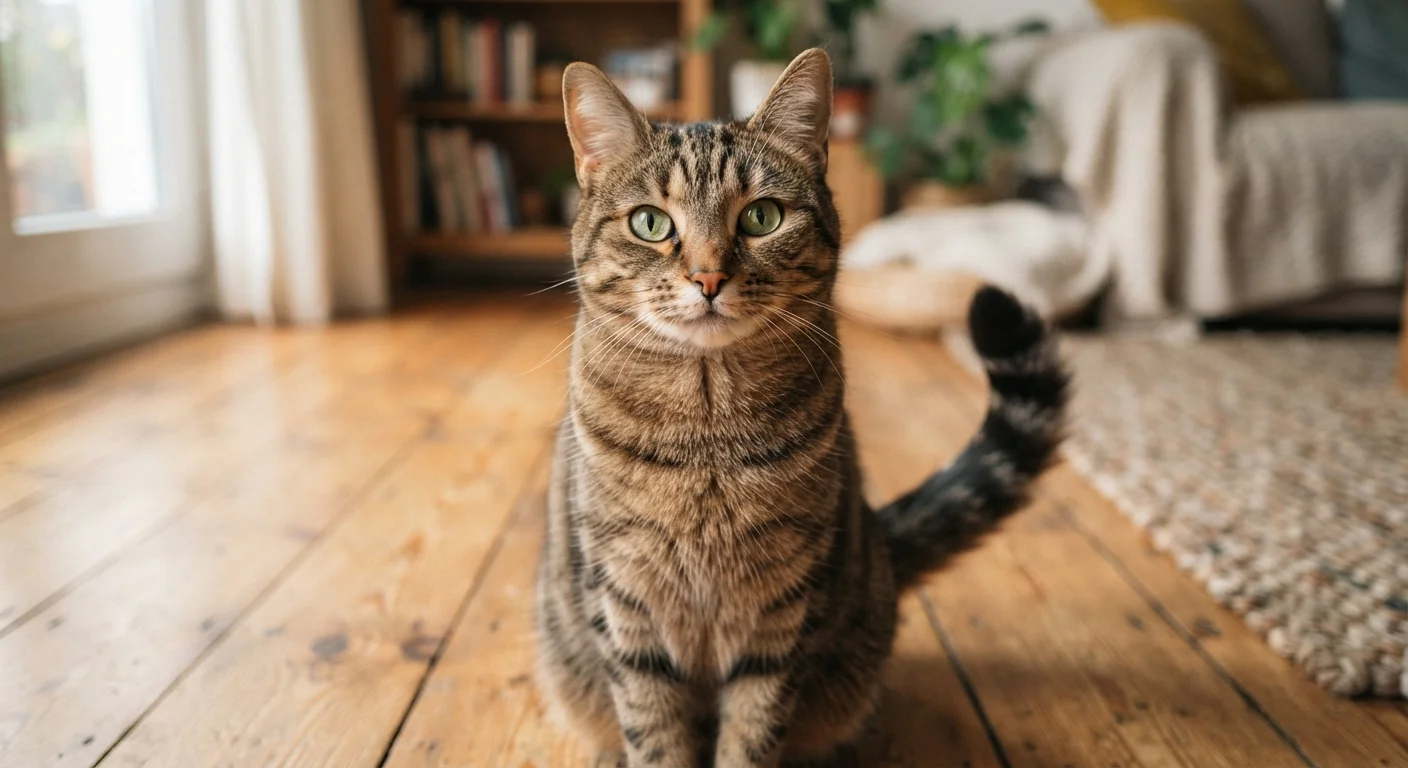
Three body regions carry the most reliable emotional information: the tail, the ears, and the overall posture. Reading them together gives a much clearer picture than any single cue alone.
Tail Positions
- Tail held high, tip slightly curled: Confidence and a friendly greeting. A cat approaching with this posture is comfortable and open to interaction.
- Tail puffed like a bottle brush: Fear or extreme agitation. The cat is making itself appear larger. Give it space immediately.
- Tail tucked low or between legs: Anxiety or submission. This cat feels threatened or unwell.
- Slow, wide tail lash: Irritation building. This is a clear stop signal - cease petting or play before it escalates.
Ear Positions
- Ears forward and slightly outward: Alert, curious, or content.
- Ears flattened sideways ("airplane ears"): Fearful or defensive. Avoid restraining the cat in this state.
- Ears pinned flat back: Aggression or intense fear. This is the highest-alert posture - do not attempt to handle the cat.
Overall Posture
- Loaf position (paws tucked under body): Relaxed and comfortable.
- Crouching low, weight back: Defensive fear - the cat may be preparing to flee or strike.
- Rolling to expose belly: Trust, not an invitation. Many cats will swipe at a hand that reaches for an exposed belly.
Slow blink
A deliberate, unhurried closing and opening of the eyes that cats use to signal relaxation and trust. Returning a slow blink to your cat is widely considered a friendly gesture in feline communication.
Piloerection
The involuntary raising of fur along the spine and tail, commonly called "puffing up." It makes the cat appear larger and signals fear or intense agitation.
Displacement behavior
A seemingly out-of-place action - such as grooming mid-play - that signals internal conflict or stress. In cats, sudden grooming during interaction can indicate the cat feels uncomfortable.
Overstimulation
A state in which petting or play exceeds a cat's tolerance threshold, triggering an abrupt shift from relaxed to defensive. Tail lashing and skin rippling are common early warnings.
Affiliative behavior
Friendly, social actions directed toward humans or other animals - including slow blinking, head-bunting (rubbing the head against a person), and kneading - that signal comfort and bonding.
Eye and Facial Signals
A cat's face - particularly the eyes - communicates nuance that tail and ear signals alone can't capture.
- Slow blink: One of the most recognized friendly signals in feline communication. A cat that slow-blinks at you is relaxed and comfortable in your presence. You can return the gesture - many cats respond positively.
- Dilated pupils in normal light: Arousal, fear, or excitement. Context determines which - pair with posture to interpret correctly.
- Constricted pupils with a hard stare: Potential aggression. Avoid direct eye contact and give the cat room to move away.
- Slow, half-closed eyes: Contentment. A cat dozing nearby with heavy eyelids is signaling it feels safe.
- Whiskers pushed forward: Interest or mild excitement. Whiskers pulled flat against the face signal defensiveness.
Facial signals become especially useful when monitoring for anxiety. If your cat regularly shows wide pupils, flattened ears, or a tucked posture without an obvious trigger, it may be worth consulting your veterinarian. Our related article on anxiety in dogs and cats covers when these patterns cross into a clinical concern.
Understanding what your cat is communicating also makes training far more effective. Rather than reacting after unwanted behavior, you can redirect it at the first sign of tension. Cat Training Is Real - Here's Where Most Owners Go Wrong explains how to apply this kind of behavioral awareness in practical training sessions.
This article is for general educational purposes and is not a substitute for professional veterinary advice. If your cat shows sudden changes in behavior or body language, consult a licensed veterinarian.