

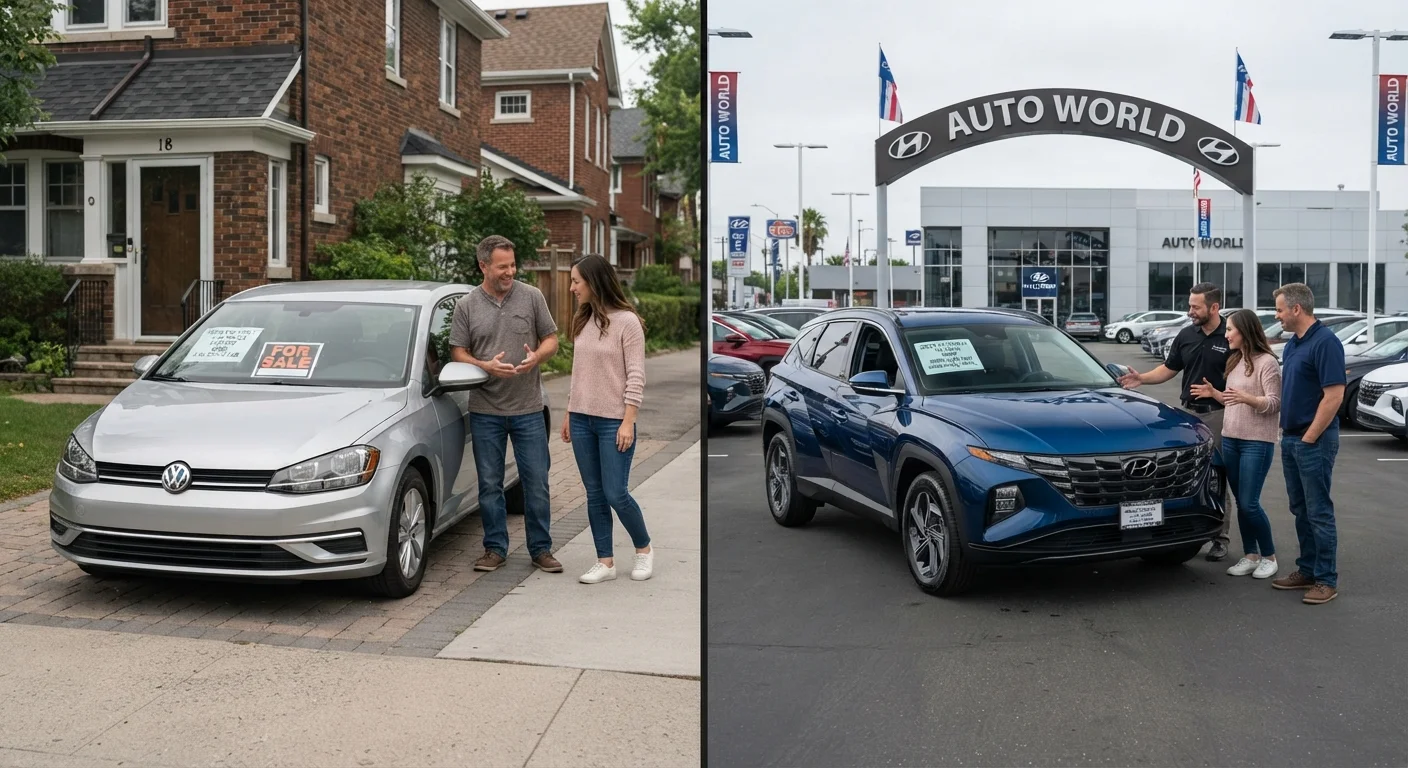
Key Takeaways
Our Verdict
Private sellers can offer meaningful savings, but those savings come with responsibility for due diligence that dealerships handle for you. Dealerships cost more upfront but provide structure, financing access, and accountability that many families find worth the premium. The right path depends on how much time, knowledge, and risk tolerance you bring to the table.
| Best for | Recommended |
|---|---|
| Buyers who can pay cash and are comfortable doing thorough vehicle research | Private Seller |
| Families who need financing and want consumer protections built in | Dealership |
| Those with a tight budget and flexibility on vehicle history documentation | Private Seller |
| First-time buyers or those with limited mechanical knowledge | Dealership |
The Core Difference: Who You're Dealing With
When you buy from a private seller, you're dealing directly with the current owner - usually someone who simply wants to move on from a vehicle. When you buy from a dealership, you're working with a licensed business that operates under state and federal consumer protection laws.
That distinction matters far beyond the sticker price. A private sale is largely governed by the principle of "as-is" - once you hand over the money, the vehicle is yours, along with any problems you didn't discover beforehand. Dealerships, depending on the state, may be required to disclose known defects, and certified pre-owned (CPO) vehicles come with manufacturer-backed warranties. Understanding key car-buying terms like CPO, as-is, and out-the-door price will help you compare offers on equal footing.
| Criterion | Private Seller | Dealership | |
|---|---|---|---|
| Typical Price | Usually lower | Usually higher | |
| Financing Options | Must arrange independently | In-house financing available | |
| Vehicle History Transparency | Varies; buyer must verify | Generally more standardized | |
| Consumer Protections | Minimal; largely as-is | State licensing and disclosure laws apply | |
| Warranty Coverage | Typically none | CPO or limited warranty possible | |
| Negotiation Flexibility | Often flexible | Structured, but negotiable | |
| Add-on Fees Risk | Low | Higher - finance office add-ons common |
Price: Private Sellers Usually Win - With Caveats
Private-party listings typically run several hundred to a few thousand dollars below equivalent dealership prices for the same make, model, year, and mileage. The reason is straightforward: a dealership has overhead - staff, facilities, reconditioning costs, and profit margin - that a private seller doesn't carry.
However, the lower price doesn't always mean lower total cost. If a private purchase later requires major repairs that a dealership's inspection or warranty would have caught, the savings can evaporate quickly. Budget-conscious families should factor in the cost of a pre-purchase inspection (typically $100-$200 at an independent mechanic) as a non-negotiable expense before finalizing any private deal.
Always Get an Independent Inspection
Before buying from any private seller, pay a licensed, independent mechanic (not one recommended by the seller) to inspect the vehicle. A thorough pre-purchase inspection can reveal hidden problems that aren't visible during a test drive. This single step can save you from a costly mistake and gives you negotiating leverage if issues are found.
For a broader view of how purchase price interacts with depreciation and long-term cost, see our breakdown of new vs. used car tradeoffs.
Financing: Dealerships Have the Edge
Most families don't pay cash for a vehicle. Dealerships make financing straightforward - sometimes too straightforward, bundling loans with add-ons that inflate monthly payments. Private sales don't come with an in-house finance office, which means you'll need to arrange your own loan through a bank or credit union before you shop.
The upside: coming pre-approved for a loan gives you real negotiating power with private sellers and dealers alike. It also means you already know your interest rate, rather than accepting whatever a dealership offers. Our guide to dealer financing vs. bank or credit union loans walks through the specific tradeoffs in detail.
One more consideration: dealerships sometimes offer manufacturer incentive rates on new vehicles - financing rates that independent lenders can't match. For used cars, those promotions rarely apply, narrowing the financing advantage considerably.
Risk, Recourse, and What Happens If Something Goes Wrong
This is where the two paths diverge most sharply. With a private seller, your recourse after a problem surfaces is limited. Small claims court is an option if you can demonstrate the seller misrepresented the vehicle, but the burden of proof and the effort involved are significant.
Dealerships operate under state lemon laws (primarily for new cars), dealer licensing requirements, and in some states, implied warranty rules that provide a baseline of consumer protection. A licensed dealer caught misrepresenting a vehicle's history risks their license - a private individual risks much less. If you're trading in a current vehicle, the dynamics shift further; see when a trade-in works in your favor before making that decision at a dealership.
Verbal Promises Don't Hold Up
In a private sale, anything not in writing is nearly impossible to enforce. If a seller tells you the transmission was just rebuilt or the brakes are new, ask for receipts before you agree to anything. Without documentation, those assurances have no legal weight if a problem surfaces after the sale.
Dealership protections don't mean dealership transactions are risk-free. Common pressure tactics and add-on fees can quietly inflate what you pay. Our article on why families overpay at dealerships explains how those patterns work.
Making the Call for Your Family
If you have the time to vet a private listing thoroughly - pulling a vehicle history report, arranging a mechanic's inspection, and securing your own financing - a private sale can deliver genuine savings. If your schedule is tight, you're less confident evaluating vehicle condition, or you need financing arranged quickly, the dealership's built-in infrastructure has real practical value.
Neither route is inherently superior. The decision comes down to how prepared you are to handle the risks each path carries - and how much you value the convenience and protections that come with a higher purchase price. Both options benefit from the same preparation: knowing what the vehicle is worth, understanding the paperwork, and not rushing the decision.
This article is for general informational purposes only and does not constitute financial or legal advice. Consult a qualified professional regarding your specific circumstances.