

Key Takeaways
Blind Spot
A blind spot is an area around your vehicle that cannot be seen directly through your mirrors. Every passenger vehicle has them - typically along the rear quarters on either side. A vehicle traveling in your blind spot is effectively invisible to you unless you physically turn your head to check.
Blind spot size varies significantly by vehicle type; SUVs, trucks, and minivans have larger blind zones than sedans. Some newer vehicles include blind-spot monitoring systems that use radar sensors to alert drivers, but these systems are aids - not substitutes for manual checks.
Why Merging Is More Dangerous Than It Looks
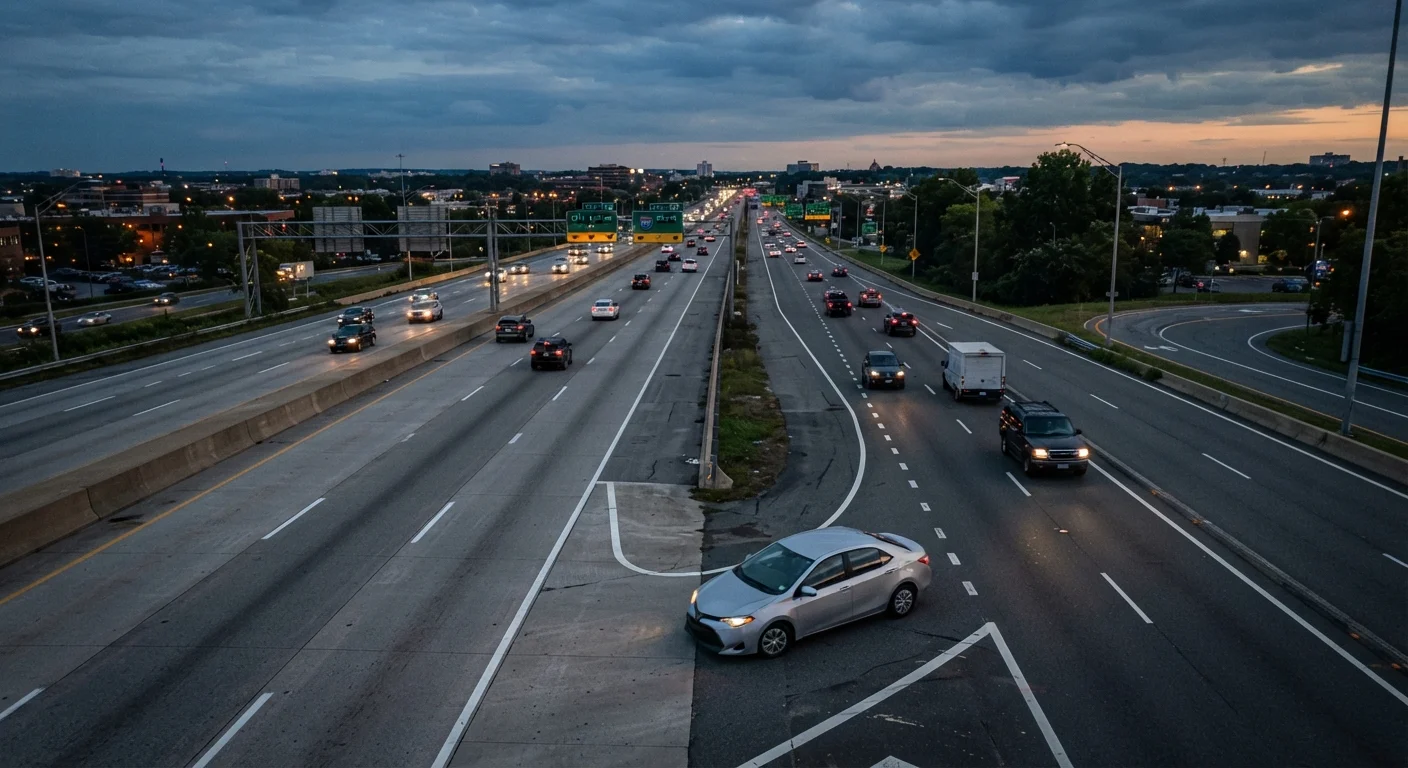
Merging feels routine, but it requires drivers to execute several tasks simultaneously: build speed, read traffic gaps, signal, steer, and yield - all within a compressed window. When any of those tasks is rushed or skipped, the consequences can be severe.
The most common merge error is arriving at the end of an on-ramp too slowly. A vehicle moving 45 mph trying to enter a lane of 70 mph traffic creates a speed differential that forces other drivers to brake or swerve. The driver who caused the problem may not even realize it. The correct approach is to use the full length of the on-ramp to reach highway speed, then signal and fit smoothly into a gap - not force one.
A second error is fixating on traffic beside you while losing awareness of what is ahead. On-ramps curve, and drivers who focus entirely on merging sometimes miss a slowing queue at the merge point. Splitting attention between your gap and the road ahead takes practice but is essential.
Match Speed Before You Merge
Treat the on-ramp as an acceleration lane, not a waiting area. Reaching highway traffic speed before merging is the single highest-impact merge habit you can build. If traffic is unusually heavy and no gap exists, slow down gradually - do not stop unless absolutely necessary, as a stopped vehicle on an on-ramp creates extreme risk.
For a broader picture of how speed differentials contribute to crashes, see our article on why following distance matters more than most drivers realize.
Understanding Your Vehicle's Blind Zones
Even with mirrors properly adjusted, every vehicle has areas where other vehicles disappear from view. These zones typically sit at the rear-left and rear-right quarters - roughly alongside your back doors and just behind your rear bumper on each side. A motorcycle or compact car can sit in that zone completely hidden while you prepare to change lanes.
Mirror adjustment reduces blind zones but does not eliminate them. The standard advice - adjust side mirrors so you can just barely see the edge of your own vehicle - is a starting point, not a solution. The physical head-check remains non-negotiable. Turn your head over the appropriate shoulder, confirm the lane is clear, then move.
~33%
Lane-change crashes among all U.S. highway collisions
According to Federal Highway Administration research, improper lane changes and merging errors are consistently among the leading contributing factors in highway crashes.
95 ft/sec
Distance covered at 65 mph in one second
At highway speeds, vehicles close the gap extremely quickly, which is why delayed shoulder checks and late signaling reduce effective reaction time to near zero.
~20%
Crashes involving blind-spot failures
NHTSA data indicates that a significant share of sideswipe and lane-change crashes involve a driver failing to detect a vehicle in an adjacent lane before moving.
Larger vehicles amplify the problem. Drivers of SUVs, pickup trucks, and minivans have wider blind zones than sedan drivers, and they may be unaware of how much more space their vehicle occupies in adjacent lanes. If you recently switched from a sedan to an SUV, recalibrating your spatial awareness should be a deliberate priority.
Conditions make blind spots worse. At night, a vehicle without functioning rear lighting may be nearly invisible in your blind zone. Rain reduces the clarity of mirror images. These compound factors are worth keeping in mind, especially if your family does a lot of long-distance highway driving.
Lane Changes: The Steps Most Drivers Compress
A safe lane change is a sequence, not a single movement. Skipping or rushing any step is where crashes begin. The full sequence: check your mirrors, signal, pause briefly to let others register your intent, perform a shoulder check, then smoothly begin the lane change while continuing to monitor mirrors.
Most drivers compress this into: glance at mirror, signal, move. The shoulder check disappears. At 65 mph, a vehicle is covering roughly 95 feet per second. In the brief moment it takes to move one lane, a vehicle in your blind spot can close significant distance.
Signaling deserves its own attention. Signaling at the moment you begin moving provides almost no useful information to drivers around you - they need time to respond. Signaling three to five seconds in advance communicates intent and gives traffic a chance to adjust. It also helps you: holding your signal for a few seconds before moving is a natural pause that creates space for the shoulder check.
Overconfidence is a real risk factor here. Experienced drivers often skip steps because they have made thousands of uneventful lane changes. That familiarity can erode the habits that made those lane changes uneventful in the first place.
Building Habits That Hold Under Pressure
Safe merging and lane-change habits are most likely to fail precisely when they are most needed: heavy traffic, unfamiliar roads, poor visibility, or when a driver is stressed or fatigued. Building technique into automatic behavior - not just conscious effort - is what keeps families protected in those moments.
For parents with teen drivers, walking through these mechanics explicitly before handing over the keys is time well spent. New drivers are taught to check mirrors and signal, but the physical shoulder check and the importance of pre-merge speed matching are frequently undertaught. Our article on family safety expectations for new teen drivers covers how to structure those conversations.
It also helps to manage your own behavior around other merging drivers. If someone is attempting to merge, adjusting your speed to create a gap - rather than maintaining position - reduces the risk for everyone on the road. That kind of cooperative driving contrasts sharply with the defensive posturing that can escalate into road rage rather than assertive driving.
This article provides general safe-driving information for educational purposes. Always follow applicable traffic laws and use your own judgment in real driving conditions. If you are unsure about driving techniques, consider working with a licensed driving instructor.