

Key Takeaways
Following Distance
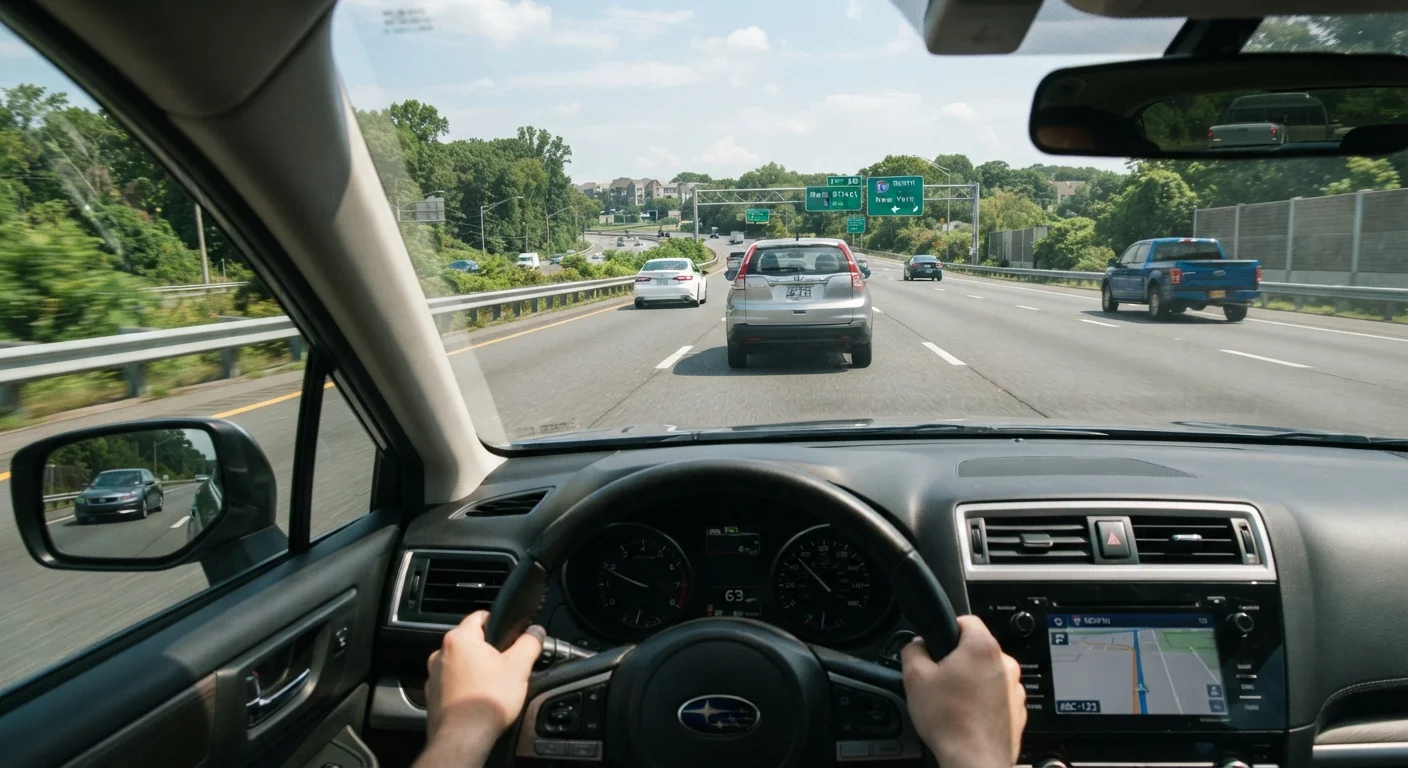
Following distance is the space you deliberately keep between your vehicle and the car ahead of you while driving. It gives you time to perceive a hazard, decide how to react, and bring your vehicle to a stop before a collision occurs. Most driving experts recommend the three-second rule as a minimum baseline under normal conditions.
Stopping distance is the sum of reaction distance (the space traveled during your reaction time, roughly 1.5 seconds on average) and braking distance (the space needed for the vehicle to physically stop). Following distance must account for both.
Why Speed Limits Only Tell Part of the Story
Speed limits are essential tools. They reflect the safest reasonable speed for a given road under ideal conditions - clear weather, dry pavement, normal traffic. But they are fixed numbers on a sign. They don't adjust for the rain falling right now, the tire tread on your car, or the split second it takes your brain to register that brake lights just lit up forty feet ahead of you.
That gap - between what a speed limit assumes and what real-world driving demands - is exactly where following distance does its most important work. Two drivers can both be traveling at the posted limit, but the one maintaining a three-second gap has roughly three times as long to react as the one riding a car-length behind. That extra time is the difference between a near-miss and a serious collision.
For more on how posted limits and actual safe speed diverge, see when driving at the limit still isn't safe.
The Physics Behind the Gap
When you decide to brake, your vehicle doesn't stop the instant your foot moves. First comes perception time - the fraction of a second your eyes and brain need to recognize a threat. Then reaction time - moving your foot from accelerator to brake pedal. The average combined perception-reaction time for a driver under normal conditions is approximately 1.5 seconds. At 60 mph, your vehicle travels about 132 feet during that window alone - before braking even begins.
Braking distance then depends on speed, vehicle weight, tire condition, and road surface. Add both together and stopping a typical passenger vehicle from 60 mph on dry pavement can require 240 feet or more. Wet roads extend that substantially.
~29%
Share of all U.S. crashes that are rear-end collisions
According to the National Highway Traffic Safety Administration (NHTSA), rear-end crashes are consistently among the most common crash types on American roads.
132 ft
Distance traveled during reaction time at 60 mph
At an average perception-reaction time of 1.5 seconds, a vehicle traveling at 60 mph covers approximately 132 feet before the driver's foot even reaches the brake pedal.
50%+
Potential increase in stopping distance on wet roads
The Federal Highway Administration notes that wet pavement significantly extends braking distances, underscoring the need for longer following gaps in rain.
Tailgating eliminates this buffer entirely. A driver one second behind another vehicle at highway speed has already traveled past most of their stopping distance before the brake pedal is fully depressed.
How to Build the Habit - and Keep It
The three-second rule is simple to use in practice. Choose a fixed point on the road - a shadow, a painted line, an overpass. When the vehicle ahead passes it, count: one-thousand-one, one-thousand-two, one-thousand-three. If you reach that same point before finishing your count, you're too close. Ease back until the gap opens.
Conditions that require a longer gap include:
- Rain or wet roads - extend to at least four seconds
- Fog or low visibility - four seconds minimum, slower speed
- Night driving - headlights cover less distance than your stopping distance at highway speed; increase the gap
- Towing a trailer or carrying a full load - heavier vehicles take longer to stop
- Following large trucks - they block your forward sightlines, reducing the warning time you have
Night driving demands additional adjustments beyond following distance alone - reduced visibility makes every gap more critical.
Adjust Your Gap Before You Need It
Don't wait for hazards to appear before opening up your following distance. When entering highway on-ramps, approaching construction zones, or driving in changing weather, increase your gap proactively. Reacting to a situation already in motion is always harder than having space to begin with.
Following Distance as a Family Safety Conversation
For families with new or teenage drivers, following distance is one of the most teachable and highest-impact habits to establish early. New drivers often underestimate how quickly situations develop at speed - their hazard-perception skills are still developing, which makes an adequate gap even more important.
Setting clear expectations before handing over the keys - including a firm rule on following distance - gives new drivers a concrete habit to anchor on, rather than relying on judgment they haven't yet developed.
It's also worth noting that habitual tailgating puts wear on your brake system over time. Sudden, frequent hard braking accelerates brake pad and rotor wear. Consistent following distance means more gradual, controlled braking - which is easier on your vehicle as well as your nerves. For more on how everyday driving habits affect your car, see habits that quietly shorten your car's life.
Following distance is also a core principle of defensive driving - giving yourself time and space to respond to what other drivers do, not just what you plan to do.