

Key Takeaways
Distracted Driving
Distracted driving occurs any time a driver's attention is diverted from the primary task of operating a vehicle safely. Distractions fall into three categories: visual (eyes off the road), manual (hands off the wheel), and cognitive (mind off the task). All three can contribute to crashes, and many common activities - including hands-free phone calls - trigger cognitive distraction even when hands remain on the wheel.
Research from the National Safety Council and NHTSA distinguishes between reaction time impairment and hazard perception loss; cognitive distraction affects both simultaneously, even when the driver believes they are paying attention.
Why Distraction Is More Than a Phone Problem
Most public conversations about distracted driving center on smartphones - and with good reason. But framing distraction as a phone problem leads drivers to underestimate a much wider range of hazards. Adjusting the radio, eating a sandwich, arguing with a passenger, or simply zoning out on a familiar route all pull cognitive resources away from the task of driving.
The NHTSA classifies driving distractions into three types: visual (eyes leave the road), manual (hands leave the wheel), and cognitive (mind drifts from driving). Smartphone use while holding the device triggers all three simultaneously, which is why it is so consistently linked to crash data. But cognitive distraction - the hardest to see from outside a vehicle - is also triggered by hands-free calls, heated conversations, and mental preoccupation with stress or plans.
Understanding the full scope of distraction matters because drivers who avoid their phone but routinely eat behind the wheel, or who believe a passenger conversation is fine because they're not looking at a screen, are still operating at reduced capacity.
Hands-Free Does Not Mean Risk-Free
Many drivers assume that switching to a hands-free device fully resolves the distraction problem. It reduces manual and visual distraction, but does not eliminate cognitive load. The National Safety Council has estimated that hands-free phone use still leaves drivers missing a significant share of the visual information in their field of view, a phenomenon sometimes called 'inattention blindness.' Understanding this distinction is important for realistic self-assessment.
The Numbers That Put Risk in Perspective
Federal data from the NHTSA consistently shows that distraction is a contributing factor in thousands of fatal crashes each year in the United States. NHTSA's traffic safety data has cited distracted driving as a factor in roughly 8-9% of fatal crash involvements annually, though researchers note that distraction is chronically underreported in crash investigations.
~8-9%
Fatal crash involvements linked to distraction
According to NHTSA traffic safety data, distraction is a reported factor in roughly 8-9% of fatal crash involvements annually - and researchers consider this figure to be an undercount.
27 seconds
Time for cognitive attention to fully return after a distraction task
AAA Foundation for Traffic Safety research found measurable cognitive impairment lasting up to 27 seconds after completing a task like sending a voice-activated text message.
~100 yards
Distance traveled while eyes are off the road for 5 seconds at 55 mph
NHTSA has used this benchmark to illustrate how briefly looking away - even for a text - covers the full length of a football field at highway speed.
One figure captures the scale clearly: at 55 mph, taking your eyes off the road for five seconds - roughly the time it takes to read a short text - means traveling the approximate length of a football field without actually watching where you're going. That distance can encompass intersections, merging vehicles, pedestrians, and sudden stops.
For families with children in the vehicle, the stakes are compounded. See our guide to driving with young children for practical strategies that balance child needs with road attention.
Why Willpower Alone Fails Behind the Wheel
Drivers routinely overestimate their ability to consciously resist distraction. The problem isn't motivation - it's how human attention actually works. The brain doesn't truly multitask; it switches rapidly between tasks, and each switch carries a cognitive cost. That cost accumulates invisibly until a hazard demands a response that simply comes too late.
Research from the AAA Foundation for Traffic Safety found that even after completing a phone-related task, measurable cognitive impairment can persist for up to 27 seconds. A driver who puts their phone down after sending a voice message may believe they're back to full attention - but their hazard perception remains degraded for nearly half a minute.
This is compounded by fatigue. A tired driver who is also distracted faces a doubled deficit in reaction time and judgment. Our article on what fatigue does to a driver explains how drowsiness undermines the same cognitive systems distraction attacks.
Set Up Your Phone Before You Start the Engine
Activating your phone's Do Not Disturb or driving mode before you shift into drive is one of the highest-impact changes you can make. It takes seconds and eliminates the temptation to respond to notifications mid-trip. Pair it with a consistent habit of placing the phone out of reach - in a bag or glove compartment - so checking it requires a deliberate stop.
Experienced drivers are not immune - years of familiarity with a route can breed a false sense of safety that makes distractions feel more manageable than they actually are.
Building Habits That Actually Work
Because in-the-moment willpower is an unreliable safety tool, the most effective strategies involve setting up your environment before you drive. This shifts the work from resisting temptation while moving at highway speeds to making a single, deliberate decision at rest.
- Use your phone's driving mode. Most smartphones have a Do Not Disturb While Driving setting that silences notifications and sends automatic replies to callers and texters. Activating it before departure removes the decision point entirely.
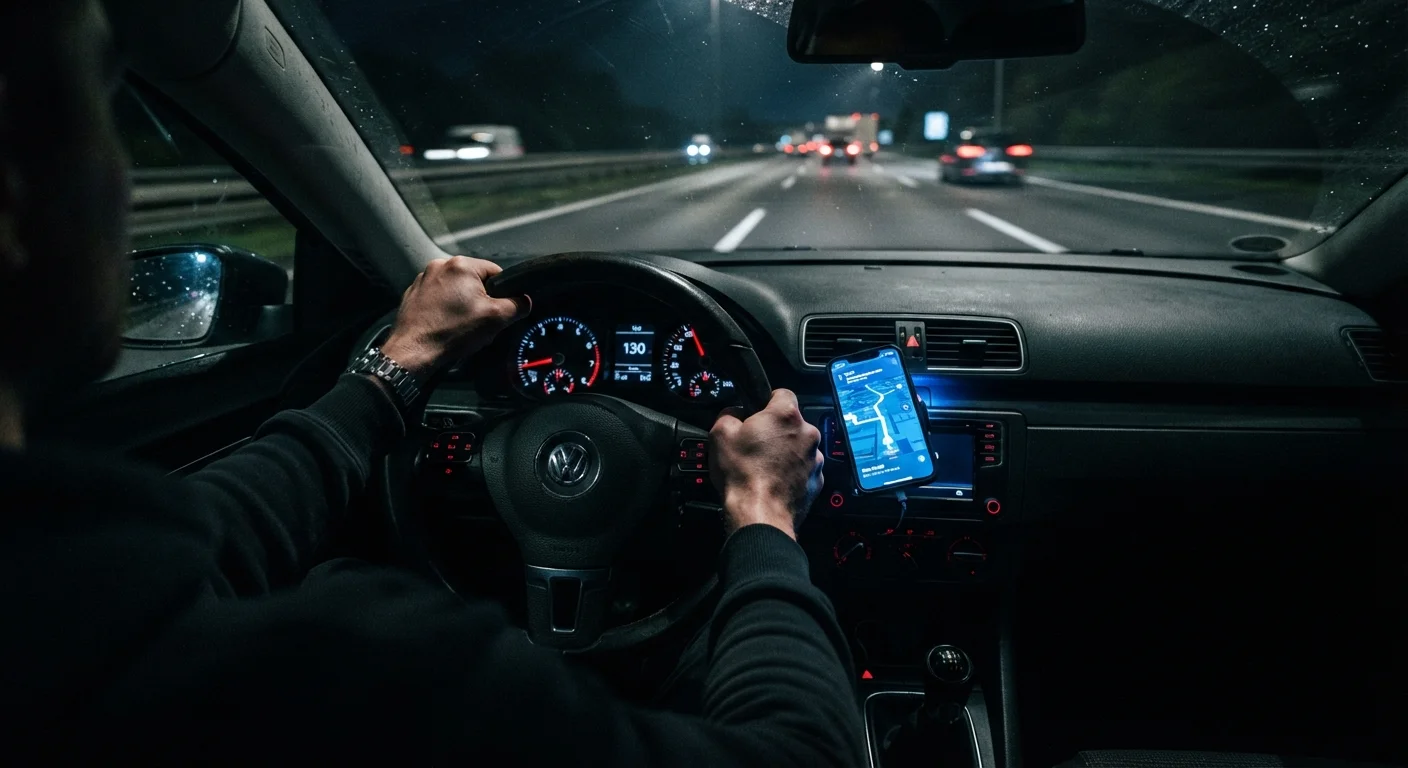
- Set navigation before moving. Interacting with a GPS while driving is a significant manual and visual distraction. Input your destination while parked.
- Settle passengers and children before departure. Snacks distributed, music agreed upon, and temperatures set - these small steps eliminate common mid-trip distractions.
- Adopt consistent following distance. A larger cushion between your vehicle and the one ahead gives more time to respond even when attention briefly lapses. See our guide on following distance for more on why this matters.
Night driving adds another layer of risk, since reduced visibility shrinks the margin for delayed reaction. Our night driving guide covers evidence-based habits for after-dark conditions where distraction is even harder to recover from.
This article provides general road safety education and is not a substitute for official driver training or local traffic law guidance. Always follow applicable laws and consult qualified sources for advice specific to your situation.