

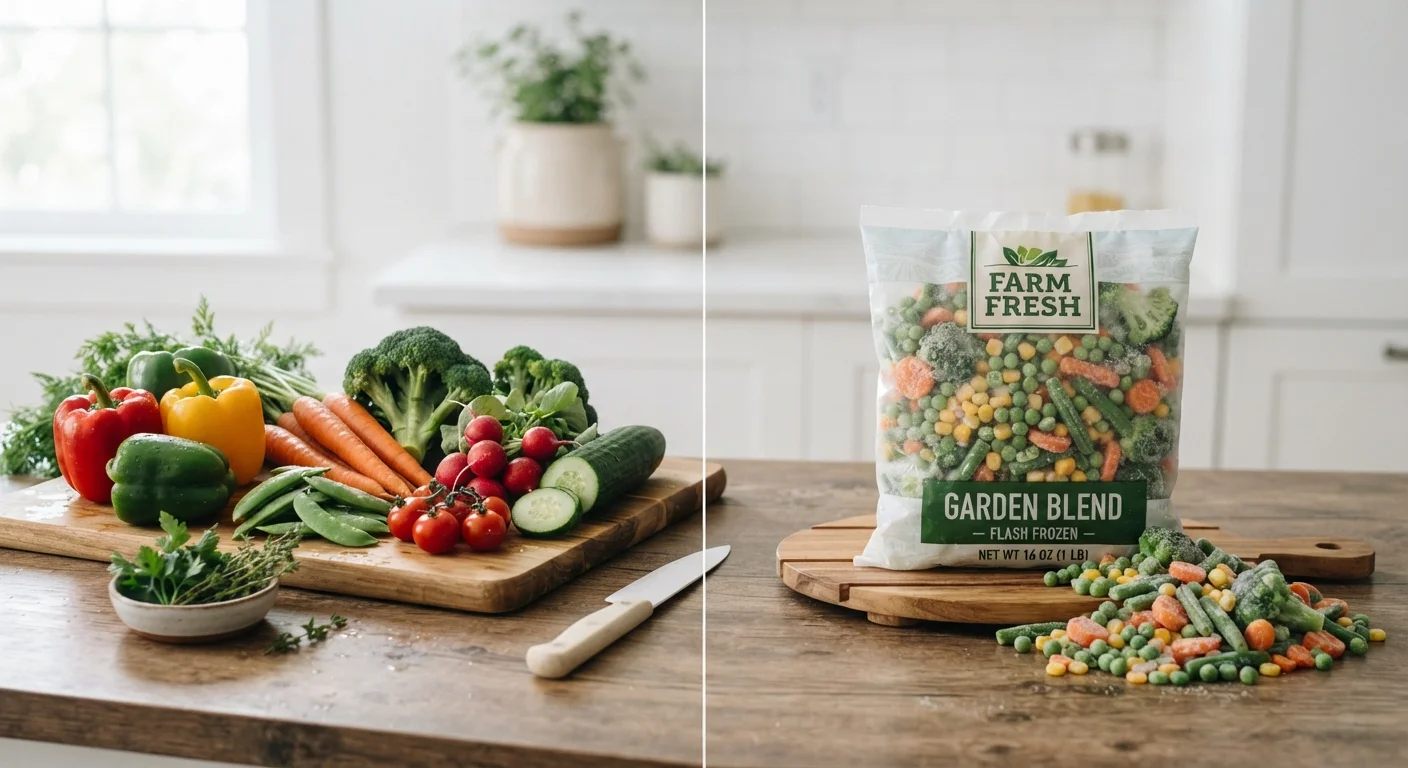
Key Takeaways
Option A
Fresh Vegetables
The familiar, market-ready standard.
Best for: Families who can shop frequently and prioritize texture, flavor, and variety for recipes where appearance matters.
Option B
Frozen Vegetables
The convenient, nutrient-locked alternative.
Best for: Families seeking consistent nutrition, reduced food waste, and lower grocery spending without daily shopping trips.
If you shop once or twice a week on a tight budget
Frozen Vegetables
Frozen vegetables cost less per serving, last weeks without spoiling, and retain strong nutritional profiles - reducing waste and stretching your grocery dollar.
If you have daily access to a farmers market or farm stand
Fresh Vegetables
Truly local, same-day-harvested produce offers peak flavor and nutrient density, especially for delicate vitamins like vitamin C that degrade during transit.
If you're trying to increase vegetable variety for your children
Frozen Vegetables
Frozen options make it easy to keep a wide range of vegetables on hand year-round, supporting consistent exposure - which research links to healthier long-term eating habits.
If texture and presentation matter for a specific meal
Fresh Vegetables
Fresh vegetables generally hold their structure better for raw preparations like salads or crudités, where frozen's softer texture would be a drawback.
If minimizing food waste is a priority
Frozen Vegetables
Frozen produce eliminates the spoilage risk that leads many families to throw away fresh vegetables before they're used, a common but avoidable nutritional and financial loss.
What Happens to Nutrients Between Farm and Table
Most shoppers assume fresh vegetables are inherently superior - a reasonable instinct, but one that research complicates considerably. The nutrient content of a vegetable begins declining the moment it is harvested. Exposure to light, heat, and oxygen all accelerate this process. Studies have found that some fresh vegetables can lose a substantial portion of their water-soluble vitamins - particularly vitamin C and certain B vitamins - within days of harvest, depending on how they are stored and transported.
Produce labeled "fresh" at a typical grocery store may have traveled hundreds of miles over several days before reaching the shelf, then sat in your refrigerator for additional days. A widely cited set of studies, including research from the University of California, Davis, found that fresh spinach, for example, can lose a significant share of folate within a week under common retail storage conditions.
This doesn't mean fresh vegetables are nutritionally depleted - far from it. It does mean that the timing and handling of fresh produce play a large role in what nutrients actually reach your family's plates. For families who shop infrequently or store produce for extended periods, these losses are worth understanding.
How Freezing Preserves Nutritional Value
Commercial freezing is not simply about convenience - it's a deliberate preservation process. Vegetables destined for freezing are typically harvested at peak ripeness and processed within hours. They are briefly blanched (exposed to steam or hot water) to deactivate enzymes that cause spoilage, then flash-frozen rapidly at very low temperatures.
This process effectively pauses nutrient degradation. Research published in journals including the Journal of Food Composition and Analysis has found that frozen vegetables frequently match or exceed their fresh-stored counterparts in key nutrients, particularly vitamin C, beta-carotene, and certain antioxidants. The nutrient edge varies by vegetable type and specific storage duration of the fresh comparison.
| Criterion | Fresh Vegetables | Frozen Vegetables |
|---|---|---|
| Nutrient retention over time | Declines continuously after harvest | Stabilized at harvest by freezing |
| Harvest timing | Varies; often pre-ripeness for transit | Typically at peak ripeness |
| Shelf life at home | Days to one week (refrigerated) | Months (frozen) |
| Average cost per serving | Generally higher | Generally lower |
| Food waste risk | Higher - spoilage is common | Lower - use only what you need |
| Texture for raw use | Firm, ideal for salads/crudités | Softer after thawing; less suitable raw |
| Year-round availability | Limited by seasonality | Consistent across all seasons |
Blanching does cause some water-soluble vitamin loss upfront - typically a modest reduction - but the subsequent frozen storage largely stabilizes what remains. By contrast, fresh vegetables continue losing nutrients gradually throughout transit and home storage with no stabilization point.
Cooking Method: The Variable That Often Matters Most
Whether you start with fresh or frozen, how you cook vegetables shapes their final nutritional value more than their pre-cooking state. Boiling vegetables in large volumes of water leaches water-soluble vitamins into the cooking liquid. Steaming, microwaving, roasting, and stir-frying generally preserve more nutrients by minimizing water contact and cooking time.
Families looking to get the most nutritional value from either fresh or frozen vegetables are well-served by quick, lower-water cooking methods. This applies equally to both categories - a properly steamed frozen broccoli floret will typically retain more nutrients than the same fresh broccoli boiled for ten minutes.
~15-55%
Vitamin C loss in fresh spinach within one week
University of California, Davis research found significant vitamin C degradation in fresh leafy greens stored under standard retail conditions.
Up to 90%
Nutrient retention possible with steaming vs. boiling
Studies in food science literature consistently show steaming preserves substantially more water-soluble vitamins compared to boiling in large water volumes.
~30%
Average household fresh produce wasted before use
USDA estimates suggest roughly a third of fresh produce purchased by U.S. households is discarded, representing both a financial and nutritional loss.
See our nutritional and financial comparison of home cooking approaches for a broader look at how preparation choices affect both nutrition and cost.
Practical Guidance for Families
The evidence does not support a simple hierarchy where fresh always beats frozen or vice versa. The most practical takeaway is that consistent vegetable consumption - in whatever form your family will reliably eat and that fits your budget - matters more than obsessing over fresh versus frozen status.
Frozen vegetables offer genuine advantages for budget-conscious households: lower per-serving cost, zero spoilage waste, and year-round availability of out-of-season produce. Families who want to expand what they grow themselves may also find value in exploring starting a vegetable garden on a tight budget as a complement to store-bought options.
Fresh vegetables remain the better choice in specific contexts: when sourced locally and consumed quickly, when raw texture is important (salads, crudités), or when a recipe is particularly sensitive to moisture content. Building a kitchen strategy around both - frozen staples for reliable, waste-free nutrition and fresh produce when timing and budget allow - reflects what nutrition research genuinely supports.
This article provides general nutrition information for educational purposes only and is not a substitute for personalized dietary advice from a registered dietitian or qualified healthcare professional.