

Key Takeaways
Our Verdict
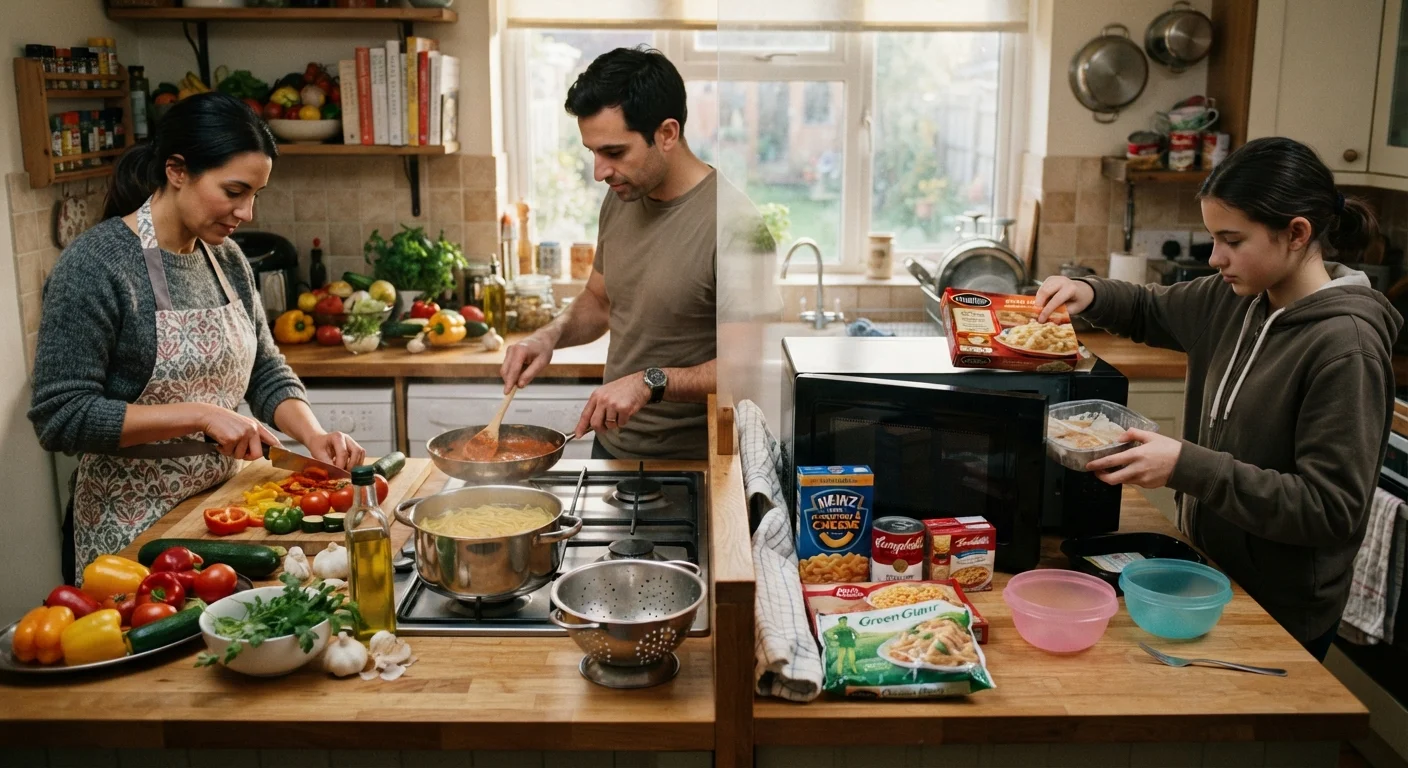
Home cooking consistently offers better nutritional control and lower per-serving costs, but convenience foods serve a real purpose in busy households. The evidence points toward a practical middle ground: prioritize scratch cooking for most meals while leaning on minimally processed convenience options when time is genuinely short.
| Best for | Recommended |
|---|---|
| Families with time to plan and prep meals | Home Cooking |
| Households managing tight weekly grocery budgets | Home Cooking |
| Extremely busy weeknights with limited prep time | Minimally Processed Convenience Foods |
| Families seeking a sustainable, flexible everyday strategy | Hybrid Approach |
The Real Cost Difference, Meal by Meal
Research published through the USDA and independent food-policy groups consistently finds that cooking from scratch costs roughly 50-70% less per serving than buying ready-made equivalents. A homemade pot of chicken and vegetable soup might cost under two dollars per serving using basic pantry staples; a comparable canned or frozen version can run three to four dollars once portion size is accounted for.
The gap widens further for families. A home-cooked pasta dinner with a simple tomato meat sauce for four people often comes in under ten dollars total. Convenience meal kits or frozen family entrees in the same category regularly exceed fifteen to twenty dollars for comparable portions.
That said, convenience foods do carry a hidden cost advantage in one area: reduced food waste. Scratch cooking requires buying ingredients in quantities that may not always be fully used, particularly for smaller households. Factoring in spoilage and leftovers is worth doing honestly when comparing true weekly spending. For more on how shopping patterns affect overall family nutrition value, see common grocery habits that quietly undermine nutrition goals.
| Home Cooking | Ultra-Processed Convenience | Minimally Processed Convenience | |
|---|---|---|---|
| Average cost per serving | $1.50-$3.00 | $3.50-$6.00 | $2.00-$4.00 |
| Sodium content | Fully controllable | Often 800-1,200 mg per serving | Moderate, varies by product |
| Added sugars | Minimal when cooking whole foods | Frequently high | Generally low |
| Fiber content | High with whole grains/vegetables | Often low | Moderate to high |
| Active prep time | 20-60 minutes per meal | 5-10 minutes | 5-15 minutes |
| Ingredient control | Complete control | None | Limited |
| Food waste risk | Moderate - requires planning | Low | Low to moderate |
Nutritional Trade-Offs: What the Labels Reveal
Ultra-processed convenience foods - a category defined by researchers using the NOVA classification system - consistently show higher levels of sodium, added sugars, saturated fat, and refined carbohydrates compared with home-cooked meals. A 2019 study published in JAMA Internal Medicine found that Americans who ate more ultra-processed foods had significantly higher intakes of added sugar and lower fiber consumption, both linked to chronic disease risk over time.
Sodium is a particular concern. Many single-serving frozen entrees contain 800-1,200 mg of sodium - roughly half or more of the daily limit recommended by the Dietary Guidelines for Americans. Home cooking allows families to control salt levels directly.
However, not all convenience foods are nutritionally equivalent. Frozen plain vegetables, canned legumes, plain oats, and rotisserie chicken - all technically convenience items - are minimally processed and nutritionally comparable to scratch-cooked alternatives. The critical distinction is the degree of processing, not the concept of convenience itself. For a closer look at one specific example, frozen vegetables vs. fresh produce explores what nutrition science actually shows about nutrient retention.
Use the Ingredient List as a Quick Nutritional Guide
When evaluating a packaged food, scan the ingredient list before the nutrition facts panel. A short list dominated by recognizable whole-food ingredients generally signals lower processing, better nutrient density, and fewer additives. Ingredients are listed by weight, so if sugar, salt, or refined oils appear in the first three positions, that product is likely not a nutritional stand-in for a home-cooked alternative.
Time, Effort, and the Realistic Family Schedule
Time is the most frequently cited reason families reach for convenience foods, and it deserves honest acknowledgment rather than dismissal. According to the Bureau of Labor Statistics' American Time Use Survey, adults with children under 6 spend an average of under 40 minutes daily on food preparation. Against a backdrop of work, school pickups, and household duties, that constraint is real.
Batch cooking - preparing grains, legumes, or proteins in larger quantities on weekends - can reduce weeknight cooking time to 15-20 minutes per meal without sacrificing nutritional quality. Slow cookers and pressure cookers similarly shift active hands-on time significantly. Practical weekly planning frameworks, like those discussed in building a week of balanced school lunches, illustrate how variety and nutrition can coexist with a realistic schedule.
On road trips or travel days, where kitchen access disappears entirely, having a strategy for eating without defaulting to fast food also matters - road trip eating strategies offers applicable thinking for those scenarios.
Building a Practical Hybrid Strategy
For most American families, an all-or-nothing approach to either home cooking or convenience foods is neither realistic nor necessary. Nutrition and budget researchers generally support a tiered model: cook from scratch for high-frequency meals like weeknight dinners and packed lunches, and reserve convenience options for genuine time emergencies - choosing minimally processed items when you do.
A few principles tend to work consistently well:
- Stock a pantry baseline: Dried beans, canned tomatoes, whole grains, and frozen plain vegetables are low-cost, nutritionally sound anchors that reduce the need for expensive convenience options.
- Identify your low-effort scratch meals: Scrambled eggs with vegetables, sheet-pan dinners, and bean-based soups require minimal skill and time but far exceed most convenience foods in nutritional quality and cost-effectiveness.
- Read labels on convenience items: Sodium content, added sugar, and ingredient list length are practical proxies for degree of processing when time is short.
Managing food spending fits within broader household budget thinking as well. The principles discussed in the budget basics hub apply directly to weekly grocery planning, and reducing reliance on high-cost convenience foods is one of the more impactful adjustments families can make.
This article is for general informational and educational purposes only. It does not constitute medical or dietary advice. Consult a registered dietitian or qualified healthcare professional for guidance tailored to your family's specific health needs.