

Key Takeaways
Why Pantry Staples Are the Real Foundation of Family Nutrition
Walk into any busy family's kitchen mid-week, and the story is familiar: limited time, a few mystery ingredients, and the recurring temptation to order takeout. What registered dietitians consistently find is that families who eat well on weeknights rarely rely on inspiration - they rely on a stocked pantry.
The staples listed below aren't trendy superfoods. They're evidence-backed, widely available, and budget-friendly ingredients that provide meaningful nutrition - fiber, plant-based protein, healthy fats, and key micronutrients - across hundreds of different meal combinations. If you're working on a broader grocery strategy, our realistic family nutrition roadmap covers how to build a full week of meals on a tight budget.
Use this list as a starting reference, not a prescription. Every family's needs differ, and a registered dietitian can help tailor food choices to specific health conditions or dietary requirements.
Dried and Canned Legumes (Beans, Lentils, Chickpeas)
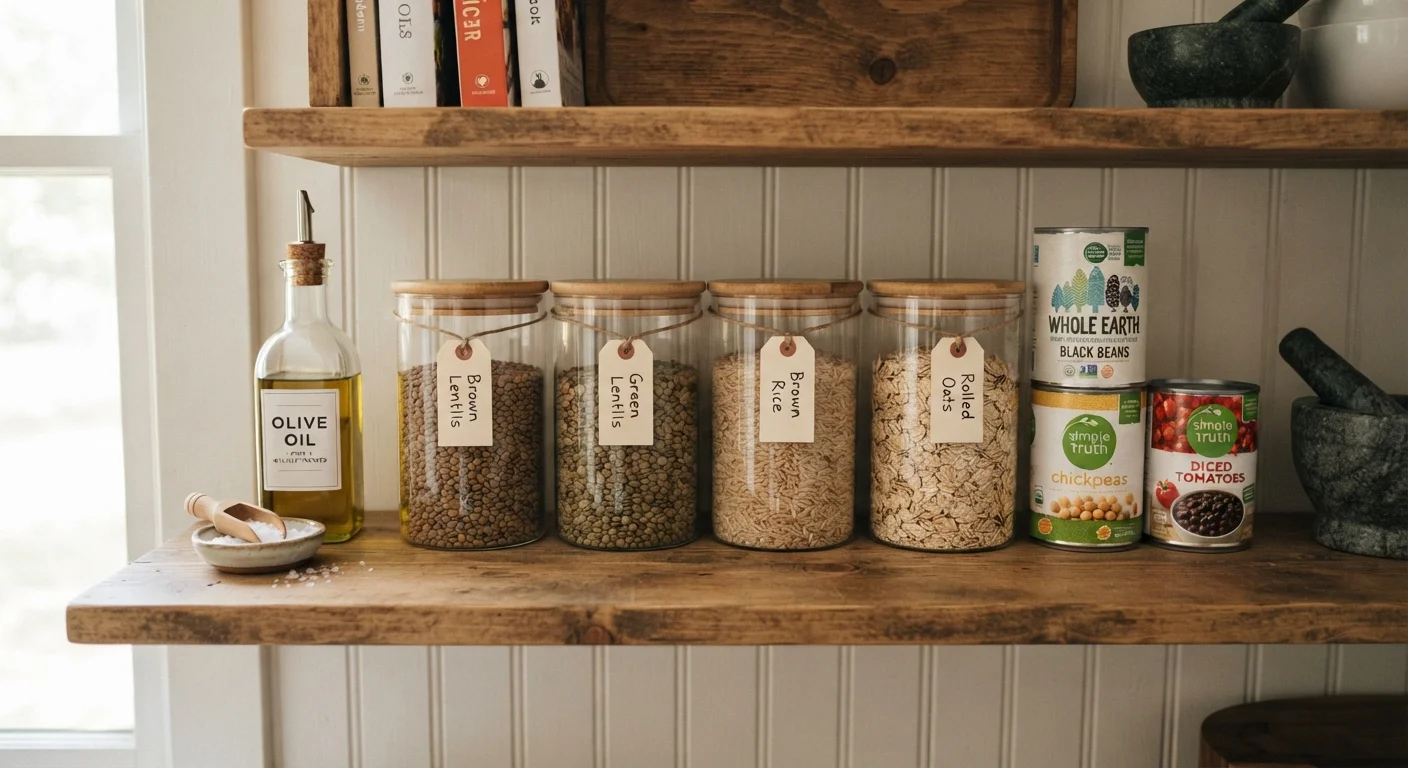
Legumes are the cornerstone of affordable family nutrition. A single cup of cooked lentils delivers roughly 18 grams of protein and 15 grams of fiber, along with meaningful amounts of iron and folate - all for a fraction of the cost of animal proteins. Canned varieties (look for low-sodium options) are ready in minutes; dried versions cost even less when you have time to plan ahead.
Dietitians favor legumes because they contribute to both satiety and gut health, and they blend into soups, tacos, grain bowls, and pasta dishes without requiring recipe overhauls. For a deeper look at plant-based protein options, see our guide on non-meat protein sources for families.
One cup of cooked lentils provides roughly 18 grams of protein at minimal cost.
Whole Grains (Brown Rice, Oats, Whole-Wheat Pasta)
Whole grains retain the bran and germ, meaning they deliver more fiber, B vitamins, and minerals than their refined counterparts. Oats make a fast, filling breakfast that supports steady energy through the morning. Brown rice and whole-wheat pasta serve as neutral bases that absorb sauces and pair with nearly any protein or vegetable.
The American Heart Association and the Dietary Guidelines for Americans both recommend making at least half of daily grain servings whole grains. Buying these in larger quantities - when storage allows - is one of the most cost-efficient moves a family can make at the grocery store.
Whole grains deliver more fiber and B vitamins than refined versions with almost identical cost.
Canned Tomatoes (Diced, Crushed, and Paste)
Canned tomatoes are a workhorse ingredient that dietitians consistently mention for good reason: they provide lycopene (an antioxidant associated with heart health in observational research), vitamin C, and potassium, and they form the base of dozens of family-friendly dishes. Tomato paste, in particular, is highly concentrated, meaning a small amount goes a long way in soups, stews, and sauces.
Unlike fresh tomatoes, canned varieties are shelf-stable, available year-round, and often more nutritionally dense because they're processed at peak ripeness. Selecting low-sodium versions when possible gives you more control over the final sodium content of a dish.
Canned tomatoes processed at peak ripeness often contain more lycopene than out-of-season fresh tomatoes.
Extra-Virgin Olive Oil
Fat is not the enemy - the type of fat matters. Extra-virgin olive oil is predominantly monounsaturated fat and contains naturally occurring polyphenols with antioxidant properties. It's the primary cooking fat in the Mediterranean dietary pattern, which has one of the strongest evidence bases in nutrition research for supporting cardiovascular and overall health.
For everyday family cooking, olive oil functions as a sauté base, a salad dressing component, and a finishing drizzle. It's more calorie-dense than some alternatives, so a little goes a long way - which also helps manage cost per use.
Olive oil's monounsaturated fats make it one of the most evidence-supported everyday cooking fats.
Canned or Frozen Fish (Tuna, Salmon, Sardines)
Fatty fish are among the best dietary sources of long-chain omega-3 fatty acids (EPA and DHA), which support heart and brain health. Fresh fish can be expensive and requires careful planning around freshness; canned and frozen options solve both problems. Canned salmon, for instance, often costs a fraction of fresh salmon and retains its omega-3 content.
The Dietary Guidelines for Americans recommend at least 8 ounces of seafood per week for adults. Introducing canned fish to family meals - in pasta, grain bowls, or simple wraps - is one of the more straightforward ways to meet that guidance without straining the grocery budget.
Canned salmon and tuna retain their omega-3 content at a fraction of the cost of fresh fish.
Eggs
Eggs remain one of the most nutrient-dense foods available at a low per-serving cost. Each large egg provides about 6 grams of complete protein (meaning it contains all essential amino acids), plus choline - a nutrient important for brain development that many Americans don't get enough of - along with vitamins D, B12, and selenium.
Their versatility is unmatched: scrambled for breakfast, hard-boiled for lunchboxes, poached over grain bowls for dinner. Dietitians increasingly emphasize eggs as a practical solution for families navigating tight grocery budgets without sacrificing nutritional quality.
Eggs provide complete protein and choline at one of the lowest costs per serving of any whole food.
Low-Sodium Broth or Stock
A quality broth transforms plain grains, simple soups, and braised vegetables into more satisfying, flavorful meals - without requiring elaborate recipes. Low-sodium versions give cooks control over salt intake, which matters particularly for households managing blood pressure or following cardiac dietary guidance.
Broth is also a practical vehicle for using up leftover vegetables or pantry odds and ends, reducing food waste. Families committed to effective meal planning often cite broth as the ingredient that ties disparate components into a cohesive weekly dinner rotation.
Low-sodium broth adds flavor and satiety to simple meals without adding significant cost or sodium.
Putting These Staples to Work Every Week
The real value of a dietitian-approved pantry isn't any single ingredient - it's the way these staples interact. Lentils add protein to a grain bowl. Canned tomatoes turn olive-oil-sautéed garlic into a pasta sauce in minutes. Oats stretch a breakfast that costs cents per serving. Together, they dramatically lower the activation energy required to cook a balanced dinner on a Tuesday.
Start With Three or Four Staples
You don't need to stock every item on this list at once. Dietitians generally recommend building a pantry incrementally - adding one or two staples per grocery run until the foundation is in place. Prioritize whichever items your family already reaches for, then expand from there. Consistency matters more than completeness.
If you're planning school lunches as well, many of these staples translate directly - consider our guide to building a week of balanced school lunches for practical applications. And if your household is just beginning to shift its eating habits, a gradual approach tends to work better than a full overhaul - see starting a family nutrition overhaul without overwhelming everyone for a beginner-friendly framework.
This article is for general informational and educational purposes only and is not a substitute for personalized medical or nutritional advice. Consult a registered dietitian or qualified healthcare professional for guidance specific to your family's health needs.