

Key Takeaways
MERV Rating
MERV stands for Minimum Efficiency Reporting Value - a standardized scale that measures how effectively an air filter captures airborne particles. The scale runs from 1 to 16 for residential and light commercial filters, with higher numbers indicating finer filtration. A higher MERV rating means the filter traps smaller particles, but it also means air has to work harder to pass through it.
MERV ratings are established by the American Society of Heating, Refrigerating and Air-Conditioning Engineers (ASHRAE) standard 52.2. Separate rating systems exist for specialized medical or industrial applications (HEPA, ULPA), which operate on different scales.
Decoding the Numbers: Size, Rating, and What They Control
Pull an HVAC filter from its slot and you'll typically find two sets of numbers: a size stamp and a MERV rating. They do completely different jobs, and mixing them up is one of the most common homeowner mistakes.
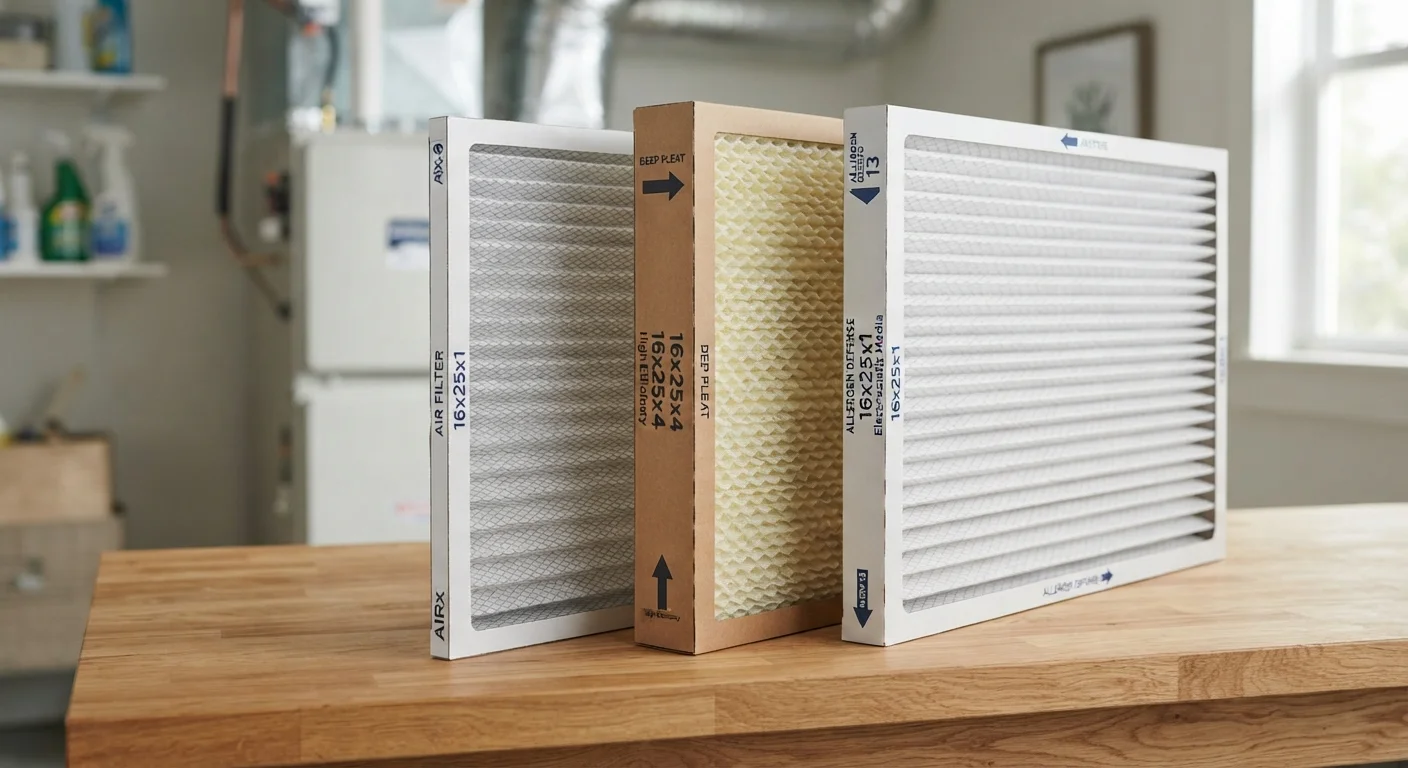
The size numbers - usually three figures like 16x25x1 - describe the filter's physical dimensions in inches (length × width × depth). The depth, or thickness, matters a great deal. Most homes use 1-inch filters, but some systems are built to accept 4- or 5-inch media filters, which last considerably longer. Always measure your existing filter or your filter slot before buying a replacement. An ill-fitting filter leaves gaps around the edges, allowing unfiltered air - and the dust and debris it carries - to bypass the filter entirely.
The MERV rating tells you how fine a net that filter casts. Here's a practical breakdown:
- MERV 1-4: Basic fiberglass filters. They protect the equipment but do little for air quality.
- MERV 5-8: Mid-range pleated filters. They capture dust, mold spores, and larger pollen particles. A solid choice for most homes.
- MERV 9-12: Higher-efficiency pleated filters. They trap finer particles including pet dander and some bacteria. Appropriate for households with allergy sufferers.
- MERV 13-16: Near-HEPA performance. These can capture very fine particles including smoke and some viruses, but they restrict airflow substantially and are only suitable for systems specifically rated to handle them.
Nominal vs. Actual Filter Size
Filter packaging often lists a 'nominal' size, which is rounded to a whole number (e.g., 20x25x1), while the actual physical dimensions may be slightly smaller (e.g., 19.75x24.75x0.75). This is normal industry practice. If you're measuring a slot rather than an existing filter, buy based on the nominal size that fills the space - the slight difference is designed into the fit.
Why Airflow Is Just as Important as Filtration
A common misconception is that buying the highest MERV rating available is always the safest choice. In practice, filtration and airflow are a trade-off. Every HVAC blower motor has a designed static pressure range - the resistance it can push air through efficiently. A filter that's too dense raises that resistance beyond safe limits.
When airflow is restricted, two things happen: your system runs longer to reach the thermostat's set temperature (raising your energy bill), and it stresses components like the blower motor and evaporator coil. In a worst-case scenario, reduced airflow across the evaporator coil causes it to freeze - a repair that can cost several hundred dollars.
Most residential HVAC systems are designed for filters in the MERV 8-11 range. If you're uncertain what your system can handle, the owner's manual or the equipment label on the air handler will sometimes list a maximum filter rating. When in doubt, a licensed HVAC technician can verify this during a routine service visit. For more context on what happens when HVAC maintenance is skipped, see what deferred maintenance actually costs.
Check Airflow Before Upgrading Filter Rating
Before switching to a higher MERV filter, hold a piece of tissue paper near your supply vents when the system is running. Noticeably weaker airflow after installing a new filter is an early sign that the rating may be too restrictive for your equipment. Downgrade one MERV level and recheck before assuming a mechanical problem.
Setting a Replacement Schedule That Actually Works
Even a correctly sized, appropriately rated filter becomes useless once it's clogged. A heavily loaded filter forces your system to work harder, effectively producing the same airflow problem as a too-dense filter - except now you're also getting poorer air quality as the filter medium becomes saturated and starts releasing trapped particles back into the airstream.
5-15%
Energy savings from a clean vs. clogged filter
The U.S. Department of Energy notes that replacing a dirty, clogged filter can lower your air conditioner's energy consumption by this range.
Every 60-90 days
Recommended replacement frequency for average homes
ASHRAE and HVAC industry guidance consistently point to this interval for standard 1-inch pleated filters in typical residential settings.
MERV 8-11
Appropriate range for most residential HVAC systems
Most residential air handlers are engineered to operate within this filtration range without airflow restriction or equipment stress.
Practical replacement guidelines by household type:
- Single occupant, no pets, no allergies: Every 90 days for a 1-inch filter.
- Average family home: Every 60 days.
- Home with pets or mild allergies: Every 30-45 days.
- Multiple pets or severe allergies: Every 20-30 days.
- 4- or 5-inch media filters: Every 6-12 months, regardless of household type, due to their greater surface area.
A simple trick: write the installation date directly on the filter's cardboard frame with a marker when you put it in. You'll see exactly how long it's been in service every time you check it. Tying filter changes to a recurring task - like paying a quarterly bill - also helps build the habit.
Just as your car's maintenance schedule keeps mechanical problems from compounding, your HVAC filter schedule prevents small issues from becoming expensive ones. The principle is the same whether you're tracking oil changes or filter swaps - see how maintenance intervals work for family vehicles for a parallel look at scheduled upkeep.