

Key Takeaways
Why Extras Matter More Than You Might Think
Most families feed their pets a commercial kibble or wet food that is formulated to be nutritionally complete on its own. The problem isn't the base diet - it's everything added on top of it. A handful of treats here, a spoonful of canned food drizzled over dry kibble there, a bit of leftover chicken from dinner: individually, each of these feels harmless. Collectively, they can quietly tip a pet into caloric excess or nutritional imbalance.
Understanding how to use treats, toppers, and table scraps thoughtfully - rather than eliminating them entirely - is a practical skill that benefits both your pet's health and your household budget. Before diving into the list, it helps to understand what your pet's diet actually requires. See what nutrients pets actually need as a foundation for everything that follows.
Apply the 10% rule to all treats
Veterinary nutritionists broadly recommend that treats - whether store-bought, homemade, or repurposed food scraps - make up no more than 10% of a pet's total daily caloric intake. This threshold exists because most treats are calorie-dense relative to their nutritional value: they add energy without meaningfully contributing protein, vitamins, or minerals in balanced proportions.
In practical terms, a 20-pound dog eating around 600 calories per day has a treat budget of roughly 60 calories. A small commercially made biscuit can run 30-50 calories on its own, which means two biscuits already fills that budget. Knowing the calorie count of your most-used treats - usually printed on the package - allows you to stay within a safe range without guesswork.
Most treats are calorie-dense but nutritionally thin - the 10% rule protects your pet's overall balance.
Adjust the main meal when you add extras
One of the most common mistakes pet owners make is treating extras as additions rather than substitutions. If your dog's base meal is already portioned to meet their full caloric needs for the day and you add a topper, several training treats, and a piece of cheese without reducing the kibble, your pet will consistently eat more than they need.
The fix is straightforward: if you know extras are coming - a training session, a food topper at dinner - reduce the base meal proportionally. This doesn't require precise measurement every time, but developing a rough sense of caloric offset makes a meaningful difference over weeks and months. Portion-sizing guidance can help you build that baseline understanding.
Add an extra, reduce the base meal - treating additions as substitutions prevents slow, steady weight gain.
Use toppers to improve palatability, not to replace balance
A topper is anything added to the surface of a pet's main meal to make it more appealing - a spoonful of canned food, a splash of low-sodium broth, a scattering of freeze-dried protein. Toppers are particularly useful for picky eaters, older pets with declining appetite, or animals recovering from illness. They can also add moisture to a dry-food diet, which some pets benefit from.
The risk is that toppers can shift the nutritional profile of what appears to be a complete diet. If a significant portion of the bowl is now topper rather than the base food, the overall nutrient ratios change - sometimes meaningfully. Keep toppers modest in volume relative to the base meal, and if your pet has a health condition that makes nutritional precision important, discuss topper choices with your veterinarian. For pets with age-related dietary needs, feeding adjustments for senior pets provides relevant context.
Toppers work best as palatability aids - not as a way to quietly replace a nutritionally complete base diet.
Know which table scraps are relatively safe - and which are not
Not all human food is dangerous to pets, but some of the most common household foods are genuinely toxic. Grapes, raisins, onions, garlic, xylitol (a sweetener found in many sugar-free products), chocolate, macadamia nuts, and cooked bones are among the items that can cause serious harm. The full picture is worth reviewing: common household foods that are toxic to pets provides a clear reference.
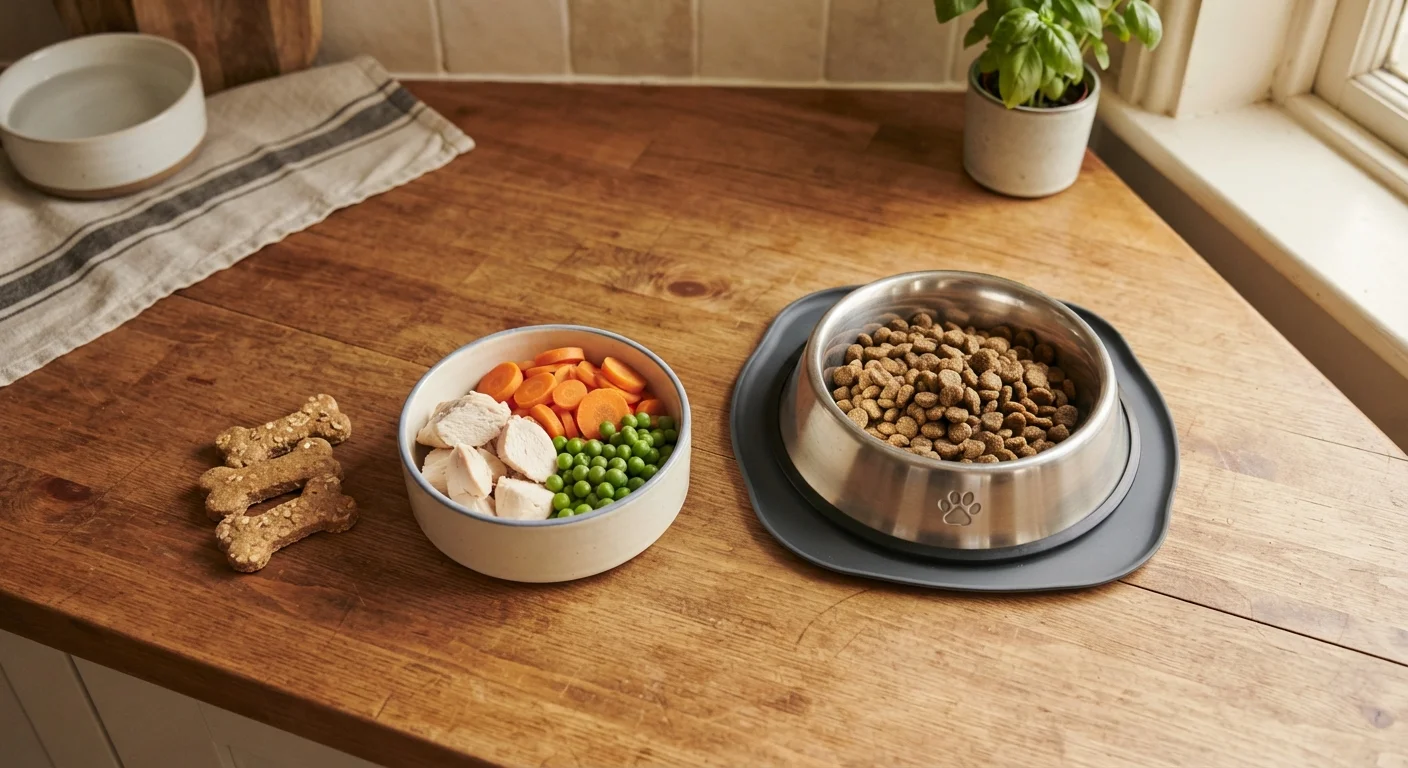
On the safer side, plain cooked lean meats (without seasoning, sauces, or added salt), plain cooked vegetables like green beans and carrots, and plain cooked rice or sweet potato are generally well-tolerated by dogs in small amounts. Cats have narrower tolerances and more strict protein requirements, so table scraps are generally a less appropriate habit for them. Even safer scraps should be offered in small quantities and not as a regular substitute for balanced nutrition.
Some everyday human foods are toxic to pets - knowing which ones matters as much as knowing the safe options.
Choose lower-calorie treat options to stretch the treat budget
For families managing costs and also trying to avoid overfeeding, low-calorie treat alternatives are worth knowing about. Small pieces of plain cooked carrot, cucumber slices, or green bean segments are accepted enthusiastically by many dogs and carry minimal caloric impact. These can be particularly useful during active training sessions where treat frequency is high.
From a budget standpoint, repurposing small amounts of pet-safe vegetables that your family already buys is often significantly cheaper than packaged specialty treats. The tradeoff is that these options don't always have the strong palatability cues - aroma, texture - of formulated treats, so they work better for some pets than others. If your household is already thinking carefully about pet food spending, budget-friendly feeding strategies covers this territory in more depth.
Plain pet-safe vegetables can serve as low-calorie, low-cost treat alternatives that stretch your treat budget further.
Read labels on commercial treats the same way you read pet food labels
Most pet owners spend time evaluating their pet's main food but reach for treats without a second glance at the label. Commercial treats vary widely in ingredient quality, calorie density, and additive content - and not all are formulated with the same oversight applied to complete pet foods.
At minimum, check the calorie count (often listed as kcal per treat or per 100g), look at the ingredient list to confirm a protein source is near the top, and note any preservatives or artificial additives you may want to avoid. Understanding how to read these labels fluently makes the process faster over time. Decoding pet food labels applies equally to treat packaging and is a useful skill to develop.
Treat labels deserve the same scrutiny as pet food labels - calorie counts and ingredient quality vary widely.
Putting It All Together
The goal isn't to eliminate the small joys of feeding your pet - treats reinforce training, toppers help picky eaters, and the occasional safe table scrap won't derail a healthy diet. The goal is to be deliberate rather than casual about what goes into your pet's bowl and when.
Because extras add up fast, it helps to track them the same way you track the main meal. If your pet's base diet is already well-calibrated to their size and activity level - check how to calibrate portion sizes properly if you're unsure - then any addition should prompt a proportional reduction elsewhere. This isn't complicated math; it's a simple habit that protects your pet from gradual weight creep.
For families watching their spending, it's also worth noting that many lower-cost extras (plain cooked vegetables, small pieces of the same protein your pet already eats) do the job just as well as packaged specialty treats. See practical approaches to feeding pets on a tighter budget for more ideas. When in doubt about any food addition, your veterinarian is the right first call - especially for pets with existing health conditions or weight concerns.
This article is for general informational and educational purposes only and is not a substitute for professional veterinary advice. Consult your veterinarian before making significant changes to your pet's diet.