

Key Takeaways
Why Package Guidelines Fall Short
Pet food manufacturers are required to print feeding directions on every bag or can, but those numbers are calculated for a hypothetical average animal at a healthy adult weight with moderate activity. Your pet almost certainly doesn't match that profile exactly - and that gap is where weight gain (or, less often, underfeeding) quietly begins.
Manufacturers also have a financial incentive to err on the generous side: more food consumed means bags run out faster. That doesn't mean the guidelines are useless - they give you a reasonable starting range - but treating them as the final word is one of the most common feeding mistakes pet owners make.
Before you adjust a single gram, it helps to understand what goes into an accurate calorie estimate. Our guide to reading pet food labels explains how to find the caloric content (listed as kcal/kg or kcal/cup) that you'll need for the steps below.
Write Down What You're Feeding Now
Before changing anything, spend three to five days logging exactly how much food - including treats and toppers - your pet actually receives each day. Most owners are surprised by how much the real total differs from their mental estimate. This baseline makes every subsequent adjustment far more meaningful.
What You Need Before You Start
Gather the following before working through the steps:
What you will need
Once you have these in hand, the process takes about 10-20 minutes and produces a daily portion target you can revisit every four to eight weeks as your pet's condition changes.
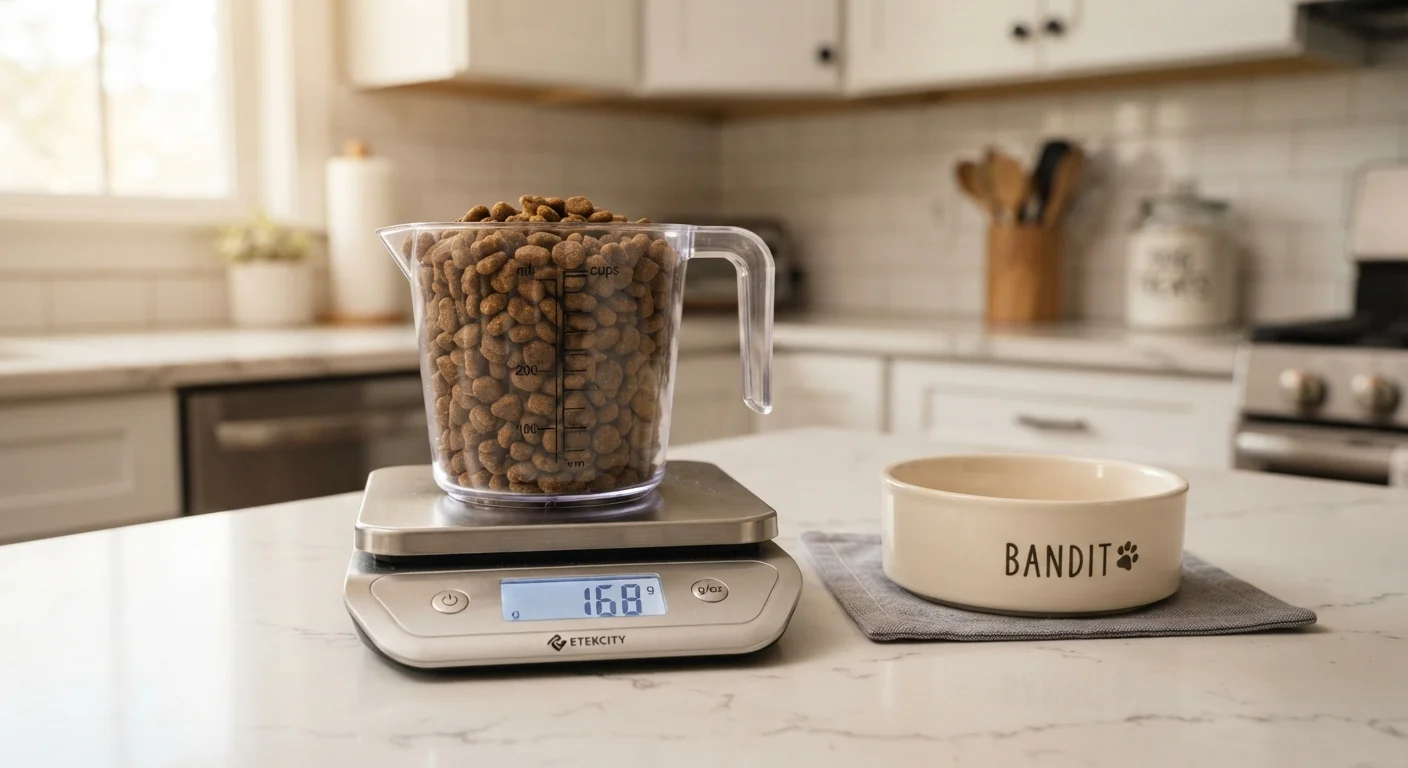
Kitchen scale
Weighs food portions in grams for greater accuracy than volumetric measuring cups.
Dry measuring cup (standard set)
Measures dry kibble portions when a scale is not available.
Bathroom or pet scale
Tracks your pet's body weight monthly so you can spot trends early.
Body condition score (BCS) chart
Illustrated reference used to evaluate whether your pet's weight distribution is within a healthy range.
How to Calibrate the Right Portion for Your Pet
Find the caloric density of your food
Look on the bag, can, or manufacturer's website for the caloric content, usually expressed as kcal per cup (dry food) or kcal per can (wet food). This number is the foundation of every calculation that follows. If you can't find it, contact the manufacturer directly - they are required to have this information available.
Assess your pet's current body condition
Body condition scoring (BCS) is a standardized 9-point scale used by veterinarians to evaluate whether an animal is underweight, at an ideal weight, or overweight - independent of the number on the scale. To perform a basic assessment at home:
- Run your hands along your pet's ribcage. You should be able to feel each rib with light pressure but not see them prominently.
- Look at your pet from above. There should be a visible waist tuck behind the ribs.
- View from the side. The abdomen should tuck up slightly, not hang level or droop.
A score of 4-5 out of 9 is generally considered ideal. Scores of 6-7 indicate overweight; 8-9 indicate obese. Scores of 1-3 indicate underweight. Ask your vet to confirm your assessment at the next visit.
Estimate your pet's resting energy requirement (RER)
The resting energy requirement (RER) is the number of calories your pet needs at complete rest to maintain basic body functions. The widely accepted formula used in veterinary nutrition is:
RER (kcal/day) = 70 × (body weight in kg)0.75
To convert pounds to kilograms, divide your pet's weight by 2.2. For example, a 22-pound dog weighs 10 kg, giving an RER of 70 × 100.75 = approximately 394 kcal/day.
Many veterinary school websites and nonprofit animal health organizations offer free online calculators that handle this math automatically if you prefer not to calculate by hand.
Apply a life-stage multiplier
RER describes rest only. Multiply it by a factor that reflects your pet's actual situation:
- Neutered adult dog or cat (typical household pet): × 1.6
- Intact adult dog or cat: × 1.8
- Inactive or obese-prone adult: × 1.4
- Weight loss (under veterinary supervision): × 1.0
- Puppy or kitten under 4 months: × 3.0
- Puppy or kitten 4 months to adult size: × 2.0
- Senior pet (7+ years, healthy): × 1.4-1.6 depending on activity
These multipliers reflect general veterinary consensus and are a starting estimate, not a prescription. Your vet may recommend a different factor based on your pet's full health picture.
Convert calories to a measurable daily portion
Divide your pet's daily calorie target (RER × multiplier) by the food's kcal per cup or kcal per can to get the daily volume or weight to serve. For example:
- Daily target: 550 kcal
- Food: 360 kcal per cup
- Daily portion: 550 ÷ 360 = approximately 1.5 cups
Split this total across your pet's regular meal schedule - typically two meals per day for adult dogs and cats.
Monitor and adjust every four weeks
Weigh your pet at home or at a pet store with a walk-on scale, and repeat your body condition assessment every four weeks. Compare the result against your target BCS of 4-5 out of 9:
- BCS increasing (gaining weight): Reduce daily portion by 10% and reassess in four weeks.
- BCS stable and within range: No change needed.
- BCS decreasing (losing weight unintentionally): Increase by 10% and consult your vet if the trend continues.
Document your numbers - portion size, weight, and BCS - so you can share the trend with your veterinarian rather than relying on memory.
After completing these steps, track your pet's weight and body condition every four weeks. If weight is creeping up, reduce the daily total by roughly 10% and reassess. If your pet seems lethargic, loses muscle, or shows a dull coat, consult your veterinarian rather than simply increasing food - those signs can point to issues beyond portion size. Our pet nutrition checkup article walks through the full list of observable signals that a diet review may be overdue.
Consult Your Vet Before Major Portion Changes
If your pet has any diagnosed health condition - including diabetes, kidney disease, heart disease, or a history of urinary issues - do not adjust portions based solely on this guide. Calorie needs for medically managed pets are often very different from the general formulas described here, and dietary changes can interact with medications or treatment plans. Your veterinarian is the right starting point for any significant feeding adjustment.
Common Factors That Change the Math
Several variables can push your pet's actual needs well above or below the package range:
- Spay/neuter status: Altered cats and dogs typically need 20-30% fewer calories than intact animals of the same weight and activity level, according to general veterinary guidance.
- Life stage: Puppies and kittens need significantly more calories per pound of body weight than adults; senior pets often need fewer, though the picture varies by individual health status.
- Activity level: A dog that runs with you daily has genuinely different needs than one who takes two short leash walks. Honest self-assessment here matters.
- Health conditions: Hypothyroidism, diabetes, kidney disease, and other conditions can dramatically alter calorie requirements. Always discuss portion adjustments with your vet when a health condition is involved.
- Extras in the bowl: Treats, food toppers, and the occasional table scrap all carry calories. See our guide to treats and toppers for a realistic look at how extras add up and which ones are relatively safer to offer.
Understanding what each macronutrient contributes also helps put portion decisions in context - our plain-language macronutrient breakdown covers exactly that. And if budget pressure is shaping how much you feed, stretching your pet food budget offers practical approaches that don't compromise nutritional adequacy.
This article is for general informational purposes only and is not a substitute for personalized veterinary advice. Consult your veterinarian before making significant changes to your pet's diet, especially if your pet has an existing health condition.