

Key Takeaways
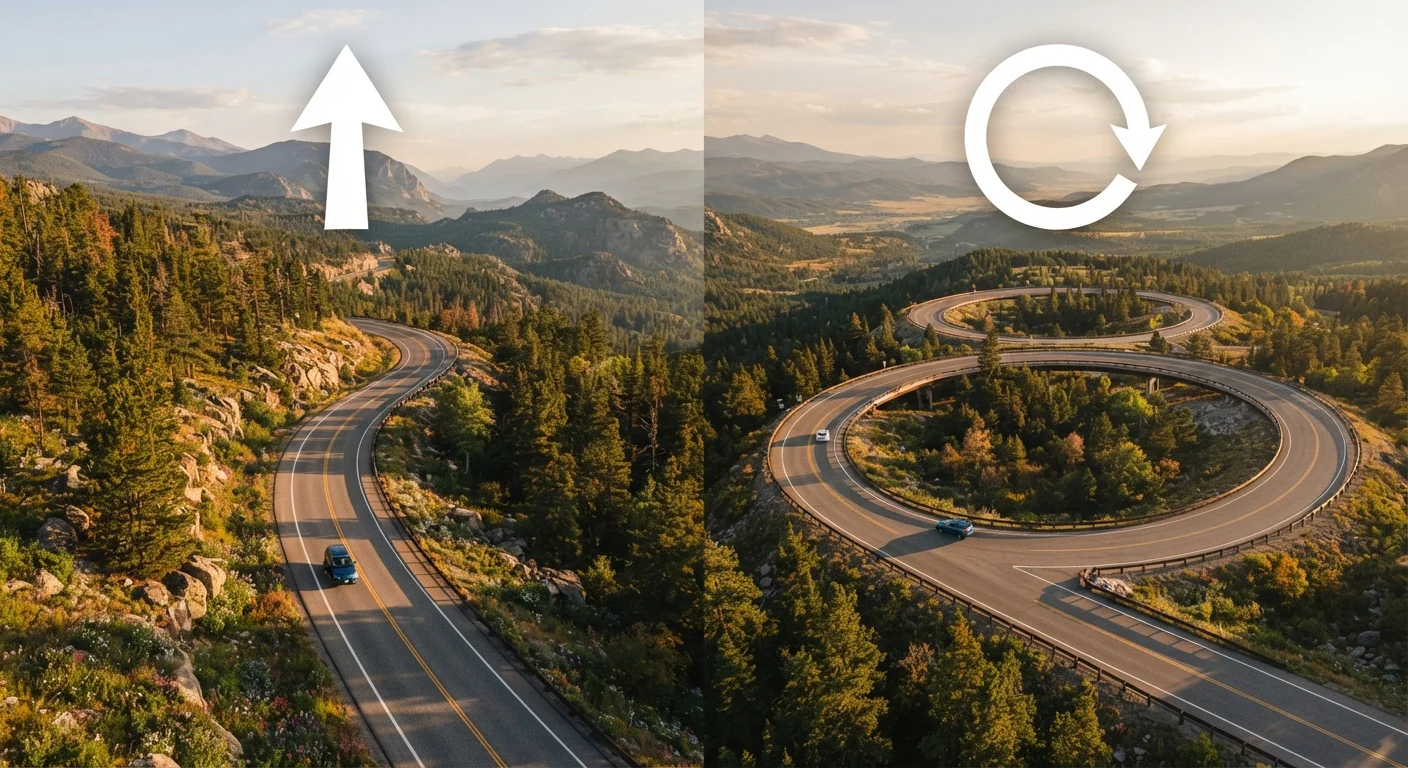
Option A
One-Way Road Trip
The linear journey that trades return logistics for maximum discovery.
Best for: Families who want to cover the most new ground and don't mind car-drop fees or coordinating a return trip.
Option B
Loop Route
The self-contained circle that keeps things simple from start to finish.
Best for: Families who want predictable logistics, a single home base, and straightforward budgeting with no repositioning hassles.
If your family has a week or less and wants simple, stress-free logistics
Loop Route
Shorter timeframes benefit from the predictability of a loop - you return to your starting point without coordinating drop-offs or second vehicles.
If you're chasing maximum new scenery and have flexibility in schedule
One-Way Road Trip
A point-to-point journey lets your family experience an entirely new stretch of country each day, with no repeated landscapes.
If keeping the trip budget tight and predictable is the top priority
Loop Route
No drop fees, no return flights or shuttles - loop routes eliminate the hidden costs that can quietly inflate a one-way trip.
If you want to combine a major destination with the journey itself
One-Way Road Trip
One-way trips let you build toward a highlight destination and stop flying through scenery just to make it home on time.
What Actually Separates These Two Route Shapes
At its simplest, a one-way road trip starts in one place and ends in another - think driving from Nashville to Denver and flying or busing back. A loop route begins and ends at the same spot, with the entire journey forming a circle or rough circuit.
That structural difference ripples through almost every aspect of the trip: how you budget, how you pack, how much flexibility you have mid-journey, and how the scenery unfolds day by day. For families weighing their options, understanding those ripple effects is more useful than simply picking whichever sounds more adventurous. Check out our guide to planning a route you'll actually enjoy for a practical walkthrough of mapping either format around your family's energy levels.
| Criterion | One-Way Road Trip | Loop Route |
|---|---|---|
| Return logistics | Requires separate plan (flight, bus, second driver) | Built into the drive - car returns to start |
| Rental drop fee risk | Yes - can add significant cost | No drop fee applies |
| Scenic variety | Maximum - all new terrain each day | Good outbound; return leg often repeats scenery |
| Flexibility mid-trip | Lower if a return flight is booked | Higher - easier to slow down or adjust |
| Total fuel cost | Often lower (no return miles) | Higher if loop covers more ground to circle home |
| Best vacation length | Two weeks or more | One to two weeks |
| Budget predictability | Moderate - return travel adds variables | High - costs are largely contained |
The Logistics and Cost Picture for Each Format
Logistics are where many families feel the real difference - and where costs can diverge more than expected.
One-Way Trips
If you're driving your own vehicle, a one-way trip means you need a plan to get home: a return flight, a bus ticket, or a second driver who brings the car back. Each of those adds cost and coordination. If you're renting a car, one-way drop fees are a genuine budget item - they vary widely by distance, region, and rental company, but families should research this cost carefully before committing. Fuel costs on a one-way trip may be lower than a full loop covering the same ground, since you're not retracing your route.
Loop Routes
With a loop, your car ends exactly where it started, return transport is built into the drive, and budgeting is more contained. The trade-off is mileage: to visit a distant destination and loop home, you'll cover more total road than a straight line would require. That means more fuel and potentially more overnight stops. For families trying to keep costs grounded, our road trip budgeting guide breaks down where dollars actually go on either route type.
$100-$500+
Typical one-way rental drop fee range
One-way rental fees vary widely by distance and company policy; families should confirm this cost before booking any rental vehicle.
~30%
Extra miles a loop may add vs. one-way
Depending on the destination, looping home rather than returning directly can add roughly 25-35% more driving distance and corresponding fuel cost.
14 days
Average American family vacation length
U.S. Travel Association data consistently shows most American families take vacations of one to two weeks, which aligns well with both route formats when planned carefully.
How Each Route Shapes the Family Experience
Beyond logistics, the route format changes the emotional rhythm of a trip in ways that matter - especially with kids in the car.
One-way routes create a natural sense of forward momentum. Every morning, you're heading somewhere genuinely new. There's no "oh, we drove through here already" moment, which keeps curiosity alive for younger travelers. The downside: as the end date approaches, you can feel pressure to push through rather than linger, especially if a return flight is locked in.
Spontaneous versus planned trips have a similar tension - the more fixed your endpoint, the less room you have to follow a detour that the kids love.
Loop routes often feel more relaxed in the back half of a trip, because you're simply working your way home rather than racing to a fixed destination. Families can more easily extend a stay somewhere wonderful or shorten a leg that isn't clicking. The repeated scenery on return legs is a real trade-off, though scenic loops planned along alternate roads can reduce this significantly.
For a broader comparison of what family travel by car actually costs versus flying, see our breakdown in Road Trip vs. Flying With Kids.
Choosing the Right Shape for Your Family
Neither format is universally better - they solve different problems. A few honest questions can help you land on the right one:
- How much time do you have? Loops work well in under two weeks; one-way trips shine when you have two weeks or more to genuinely explore a corridor.
- Is returning to your starting point easy? If home is a hub airport with affordable flights, one-way trips become much more practical. If getting back is complicated or expensive, a loop usually wins.
- Does your family recharge through novelty or familiarity? Some kids thrive on constant new scenery; others settle into a trip better when the return journey feels familiar and predictable.
- What's driving your route? A single anchor destination (a national park, a family reunion) often suits a loop. A destination corridor - say, Route 66 or the Pacific Coast Highway - is almost always better as a one-way journey.
Whatever format you choose, be aware that hidden costs and poor route planning can inflate either type of trip. Knowing your route shape in advance helps you anticipate and avoid the most common budget leaks.