

Key Takeaways
Why Poor Soil Is Worth Fixing - Not Just Working Around
If your garden plants struggle, bolt early, or never thrive despite regular watering, the problem is often beneath the surface. Clay soil drains poorly and becomes hard as concrete in dry spells. Sandy soil drains too fast, leaving roots dry and nutrient-starved. Compacted soil - common in yards with heavy foot traffic or recent construction - chokes out oxygen and makes root growth nearly impossible.
Many families assume their only options are expensive landscaping services or switching entirely to raised beds. But in-ground soil can be rehabilitated gradually with low-cost inputs and consistent practice. Before you spend anything, a simple soil test (available through many cooperative extension services for a modest fee) tells you your soil's pH and basic nutrient levels - so you target real deficiencies rather than guessing. If you're still weighing whether to improve your ground soil or work around it, see our comparison of raised beds and in-ground planting to understand the trade-offs.
The strategies below are arranged to build on each other. Start with whichever fits your timeline and budget, and add more as the seasons progress.
Add homemade or free compost regularly
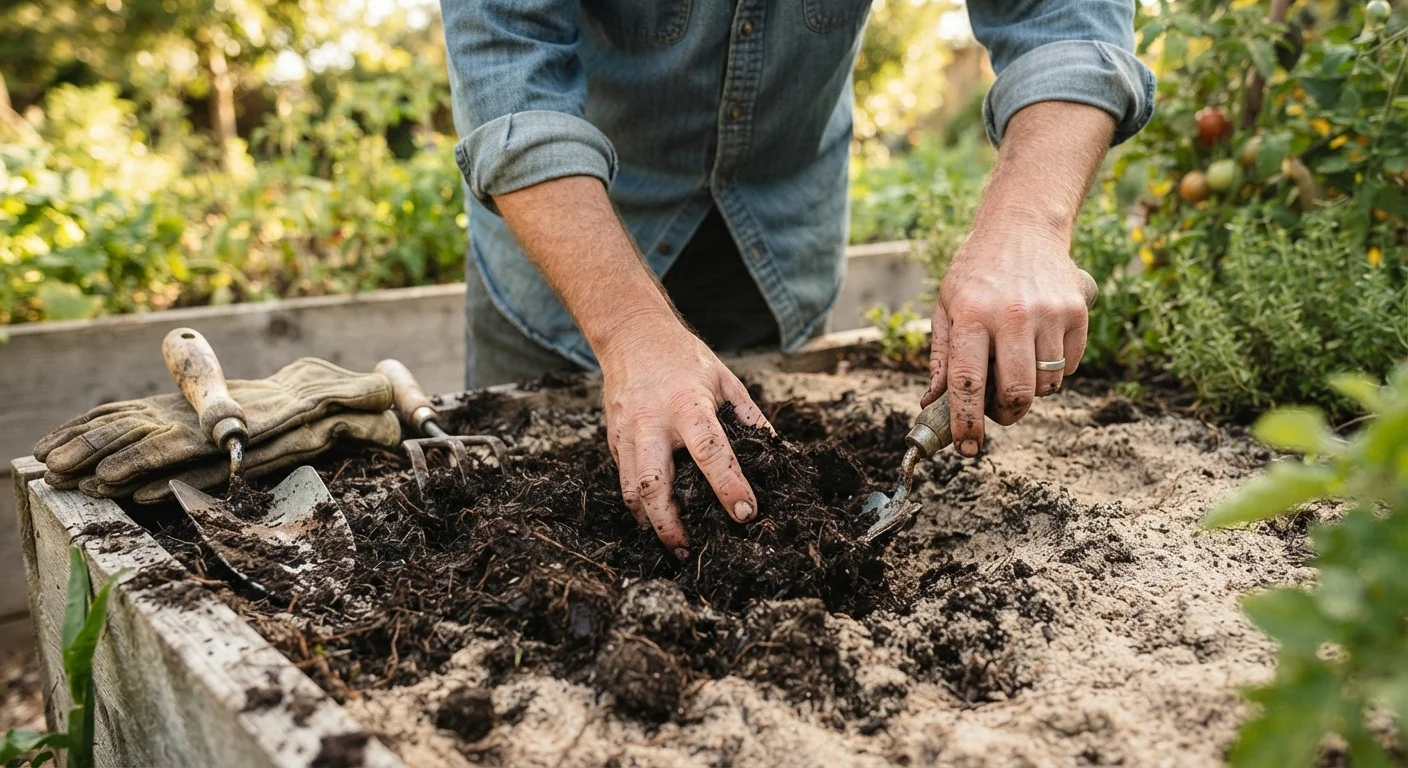
Compost is the most versatile soil amendment available, and it costs very little to make at home. A basic compost pile needs only a balance of brown materials (dried leaves, cardboard, straw) and green materials (vegetable scraps, grass clippings, fresh weeds without seed heads). Turning the pile every week or two speeds decomposition.
Apply a 1-2 inch layer of finished compost over garden beds each spring and work it lightly into the top few inches of soil. Over time, compost improves drainage in clay soil, increases water retention in sandy soil, and adds slow-release nutrients to both. Many municipalities also offer free or heavily subsidized finished compost at drop-off sites - worth checking before buying bagged products.
Compost addresses clay, sandy, and compacted soil problems simultaneously - no single amendment does more.
Use mulch to protect and slowly enrich the surface
A 2-3 inch layer of organic mulch - shredded leaves, wood chips, straw, or grass clippings - does double duty. It suppresses weeds, reduces moisture evaporation, and moderates soil temperature. As it decomposes, it adds organic matter to the top layer of soil.
Shredded fallen leaves are essentially free in most yards every autumn. Grass clippings from an untreated lawn can be spread thinly between plants. Municipalities and tree-trimming services sometimes offer free wood chip mulch in bulk. Keep mulch an inch or two away from plant stems to prevent rot. For a deeper look at applying mulch correctly, see common mulching mistakes to avoid.
Free leaf mulch from your own yard breaks down into valuable organic matter over a single winter.
Plant cover crops in the off-season
Cover crops - also called green manures - are plants grown specifically to improve soil rather than for harvest. Common options include winter rye, crimson clover, buckwheat, and hairy vetch. Seed packets for cover crops are inexpensive and a little goes a long way.
These plants protect bare soil from erosion and compaction during wet or cold months. Legume varieties (clovers, vetch) fix atmospheric nitrogen into the soil, reducing the need for added fertilizer. When you till or cut them down before they go to seed in spring, the plant matter decomposes and feeds soil organisms. For small family gardens, even covering a 4-by-8-foot bed with clover over winter adds measurable organic matter by spring.
Legume cover crops can fix atmospheric nitrogen into your soil at almost no cost.
Break up compaction with deep-rooted plants or minimal tillage
Compacted soil has poor air and water movement because soil particles are pressed tightly together. One chemical-free approach is to grow deep-rooted plants like daikon radishes or tillage radishes, sometimes called "tillage radishes" or "bio-drills." Their roots penetrate hardpan layers, and when they decompose, they leave channels that improve drainage and aeration.
Alternatively, a broadfork - a long-handled, two-pronged fork - lets you loosen soil to a depth of 10-12 inches without fully inverting it. This preserves the soil's layered structure and microbial communities while relieving compaction. Broadforks require no power and last for many years. Avoid working soil when it's very wet, as that worsens compaction rather than relieving it.
Deep-rooted radishes can break up compacted subsoil layers without any digging on your part.
Adjust pH with lime or sulfur before adding other amendments
Soil pH - a measure of acidity or alkalinity on a scale of 1 to 14 - affects how well plants can access nutrients already present in the soil. Most vegetables and flowers do best in a range of roughly 6.0 to 7.0. If your soil test reveals pH outside that range, nutrients become "locked out" regardless of what else you add.
Agricultural lime (ground limestone) raises pH in acidic soils. Elemental sulfur lowers pH in alkaline soils. Both are sold in small bags at modest cost and are applied in the fall so they have time to work before the next growing season. Follow your soil test recommendations for quantities - applying too much can overshoot the target. This is a targeted fix, not a routine annual input.
Correcting pH before adding fertilizer ensures nutrients already in your soil become available to plants.
Feed soil life with worm castings or diluted liquid inputs
Healthy soil contains billions of microorganisms - bacteria, fungi, and other organisms - that break down organic matter and make nutrients available to plant roots. Worm castings (vermicompost) are an exceptionally concentrated source of these beneficial organisms and the nutrients they cycle.
A small worm bin can be maintained indoors or in a garage with kitchen vegetable scraps. It takes up little space and produces rich castings within a few months. A small handful of castings per transplant hole, or a diluted "worm tea" (soaking castings in water and applying as a drench), gives seedlings a measurable early boost. This approach works well alongside compost rather than replacing it - think of castings as a targeted supplement for individual plants.
A small worm bin converts kitchen scraps into high-quality soil amendment year-round, indoors or out.
Building on Your Soil Work Season After Season
No single intervention transforms poor soil overnight. The gardeners who see the most improvement are those who combine two or three of these methods consistently across successive seasons. Compost while you mulch. Plant a cover crop in fall after your last harvest. Let grass clippings break down in place rather than bagging them.
Start small and track your results
Choose one or two beds to focus your soil-improvement efforts in the first season rather than trying to amend your entire yard at once. Take a photo of your soil and plants at the start of each season so you can compare progress over time. Simple notes about what you added and when help you identify which methods are working best for your specific soil type.
This patient, layered approach is also the backbone of planning a garden from scratch, where soil preparation is built into every seasonal phase. And if your goal is food production on a tight budget, many of these soil-building inputs - kitchen scraps, fallen leaves, free municipal compost - also feature in starting a vegetable garden affordably. Healthy soil is the foundation that makes every other gardening investment go further.