

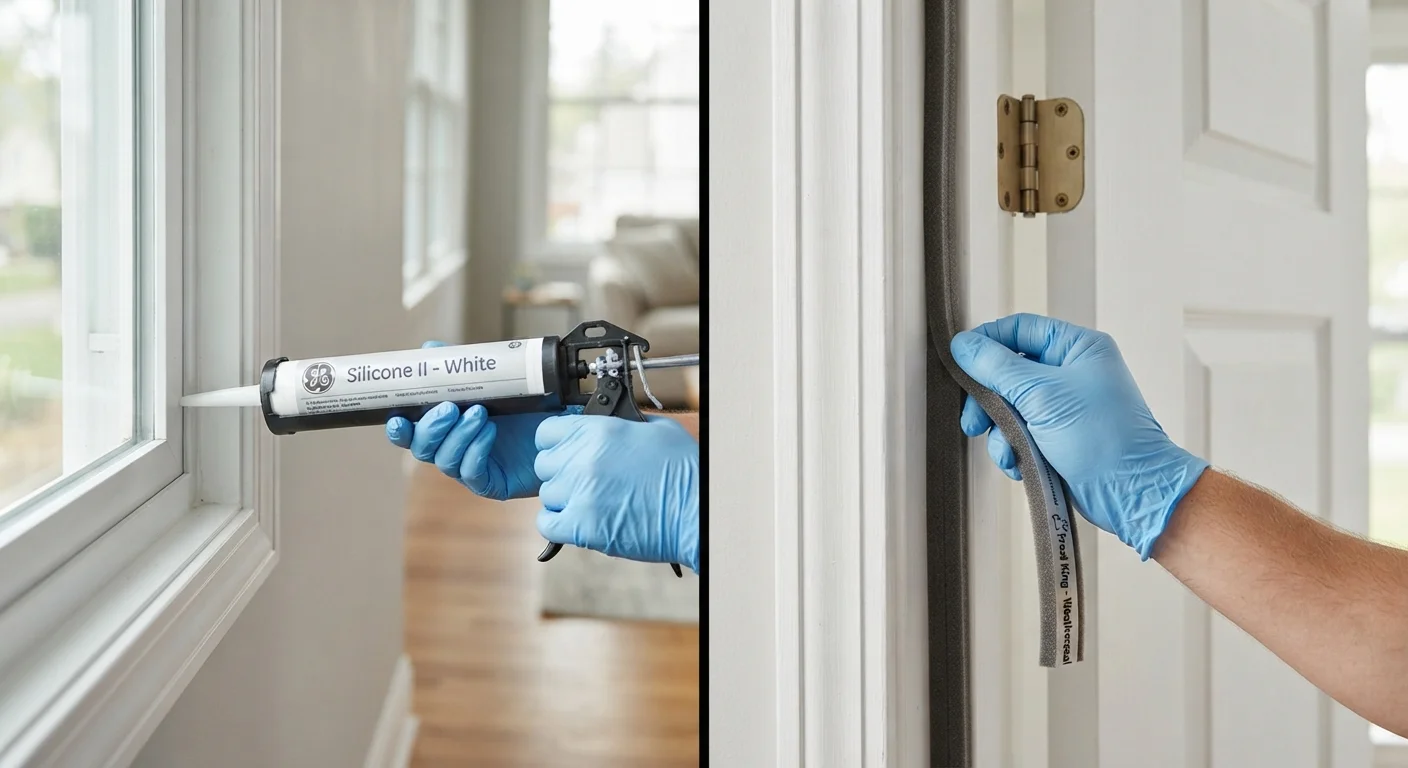
Key Takeaways
Option A
Weatherstripping
The movable-joint specialist designed for doors and operable windows.
Best for: Sealing gaps around parts of your home that open and close regularly, like door frames and casement windows.
Option B
Caulking
The flexible adhesive filler built for stationary cracks and seams.
Best for: Filling fixed gaps around window frames, baseboards, plumbing penetrations, and other non-moving surfaces.
If you're sealing a drafty exterior door
Weatherstripping
Door edges compress and release with every use; caulk would crack quickly under that repeated movement.
If you're sealing the fixed frame of a window to the surrounding wall
Caulking
That joint is stationary and benefits from caulk's adhesive bond and paintable finish.
If you want to reduce heating and cooling bills throughout the home
Both
A complete air-sealing strategy uses weatherstripping on operable joints and caulk on all fixed gaps for maximum coverage.
If moisture is entering around a bathtub or sink
Caulking
A waterproof silicone or siliconized latex caulk creates the flexible, watertight seal wet surfaces require.
The Core Difference: Movement vs. Stillness
Homeowners often reach for whichever product is handy when they spot a gap, but weatherstripping and caulking are engineered for fundamentally different conditions. The single most important question to ask before buying anything is: does this gap move?
Weatherstripping is a compressible material - foam, rubber, felt, or vinyl - designed to form a seal that can flex open and close thousands of times without tearing or losing its shape. It belongs anywhere a moving surface meets a stationary frame, most commonly along the top, bottom, and sides of exterior doors and operable windows.
Caulking, by contrast, is a semi-flexible sealant applied as a bead and left to cure into a solid joint. It bonds two surfaces together permanently enough to block air and water, but it cannot survive repeated mechanical stress. Apply it where parts shift or flex and it will crack within a season. For a deeper look at why caulk fails prematurely, see our guide to caulk cracking.
| Criterion | Weatherstripping | Caulking |
|---|---|---|
| Best for | Moving joints (doors, operable windows) | Fixed gaps and seams |
| Typical lifespan | 1-10 years depending on type | 5-10 years (shorter in wet areas) |
| Application skill required | Low - measure, cut, press | Low - clean, bead, smooth |
| Paintable | Generally no | Yes (latex types) |
| Waterproofing ability | Moderate (compression seal) | High (silicone types) |
| Survives repeated movement | Yes - designed for it | No - cracks under flexing |
| Common failure mode | Compression set, tearing | Cracking, loss of adhesion |
Where Each Material Belongs in Your Home
A useful mental map: think of your home's envelope as two categories - hinged or sliding joints and fixed seams. Weatherstripping covers the first category; caulk covers the second.
Weatherstripping locations
- Exterior door perimeter (sides, top, and door sweep at the bottom)
- Garage door edges and bottom seal
- Operable casement or double-hung windows along the sash
- Attic hatch perimeter, if it opens regularly
Caulking locations
- Window frame-to-wall joint on the exterior
- Gaps around pipes, wires, or ducts penetrating walls or floors
- Baseboards meeting walls or floors in unconditioned spaces
- Bathtubs, showers, sinks, and countertop edges
- Gaps between foundation sill plate and framing
Some locations call for both. An exterior door, for example, needs weatherstripping along the moving sash but caulk where the stationary door frame meets the exterior siding. Getting this distinction right is the foundation of an effective air-sealing strategy. For a broader overview of all three draft-stopping methods, including insulation, see our plain-language primer.
Up to 30%
Home heating/cooling lost through gaps and cracks
The U.S. Department of Energy estimates that air leaks through gaps, cracks, and openings can account for up to 30% of a home's heating and cooling costs.
$50-$100
Typical DIY cost to seal an average exterior door
A full door weatherstripping kit and supplementary caulk for the frame are generally available at hardware stores for well under $100 combined.
1-3 years
Average lifespan of basic foam weatherstripping
Low-density foam tape degrades faster than rubber or V-strip alternatives, especially on high-traffic exterior doors exposed to temperature extremes.
Choosing Materials and Applying Them Correctly
Both tasks are accessible for beginners, but the right product selection makes a measurable difference in how long the repair lasts.
Weatherstripping types at a glance
Foam tape is inexpensive and easy to cut to length - good for irregular gaps but typically lasts only one to three years. V-strip (tension seal) is a durable folded plastic or metal strip that fits inside window channels and door stops; it handles compression well and can last a decade or more. Door sweeps attach to the door bottom and drag across the threshold, blocking the gap that foam tape can't reliably cover.
Caulk types at a glance
Silicone caulk offers the strongest waterproofing and longest lifespan, but it cannot be painted and requires careful surface prep. Latex or acrylic latex caulk is paintable, easier to clean up with water, and suitable for most interior trim and window joints. Siliconized latex blends both properties and is a practical choice for exterior window frames and door frames where painting is needed.
Application tips
- Clean and dry all surfaces before applying either product - adhesion fails on dust, grease, or moisture.
- For caulk, cut the nozzle at a 45-degree angle and apply steady pressure for a consistent bead; tool the joint with a damp finger or plastic spoon before it skins over.
- For weatherstripping, measure and cut to exact length, peel adhesive backing slowly, and press firmly from one end to avoid bubbles.
Maintain your seals on a simple annual schedule: check weatherstripping each fall before heating season and replace any strips that are flattened, torn, or no longer spring back. Caulk typically needs attention every five to ten years, though wet areas like tubs should be checked more often. If you notice cracking or gaps returning quickly, the causes of repeated caulk failure are worth reviewing before you reapply.