

Key Takeaways
Pet Food Label
A pet food label is the regulated set of information printed on every commercial pet food package. It includes the product name, ingredient list, guaranteed analysis, nutritional adequacy statement, and feeding guidelines - each section governed by rules set by the Association of American Feed Control Officials (AAFCO) and enforced at the state level. Together, these elements tell you what a food contains, whether it meets established nutritional standards, and how much to feed your pet.
AAFCO publishes official nutrient profiles for dogs and cats that manufacturers must meet or exceed to use the phrase 'complete and balanced' on their packaging.
The Five Sections That Actually Matter
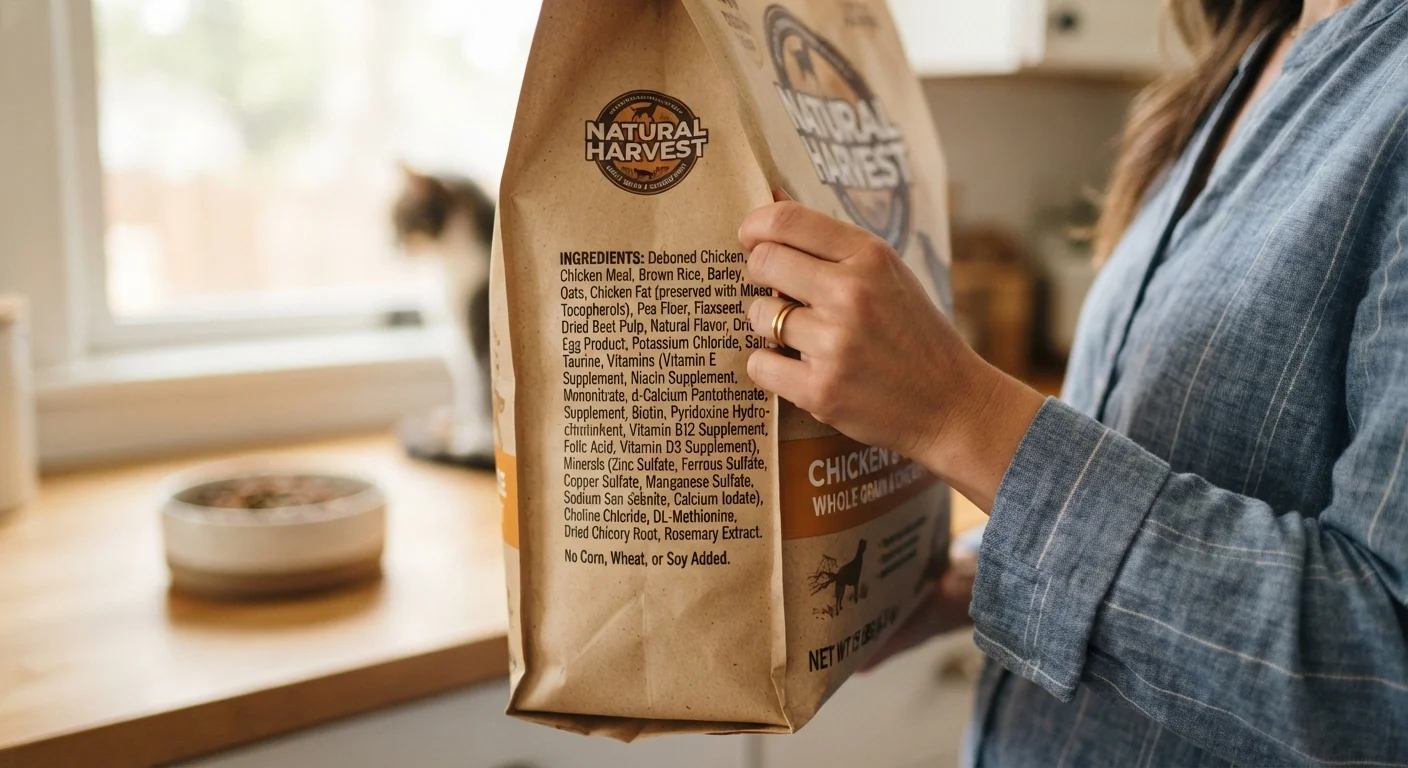
Every commercial pet food bag or can sold in the United States must carry five regulated elements. Understanding each one lets you cut through marketing language and focus on what the food actually delivers.
- Product name: Strict AAFCO naming rules determine how much of a named ingredient the food must contain. A food labeled "Chicken for Dogs" must be at least 95% chicken by dry weight. "Chicken Dinner" or "Chicken Entrée" drops that threshold to 25%. "With Chicken" requires only 3%, and "Chicken Flavor" requires no minimum amount at all.
- Ingredient list: Ingredients appear in descending order by pre-cooking weight. The first five to seven ingredients generally make up the bulk of the formula.
- Guaranteed analysis: Four core values are required - minimum crude protein, minimum crude fat, maximum crude fiber, and maximum moisture. Some manufacturers voluntarily list additional nutrients.
- Nutritional adequacy statement: This sentence tells you whether the food is complete and balanced, and for which life stage - growth (puppies/kittens), adult maintenance, or all life stages.
- Feeding guidelines: Suggested daily amounts by the pet's weight. These are estimates, not prescriptions. See our guide to portion sizing for how to calibrate from there.
Decoding the Ingredient List
The ingredient list is the section most pet owners spend the most time on - and the one most prone to misreading. A few principles help.
Pre-cooking weight inflates meat rankings. Whole chicken, for example, is roughly 70% water. After processing, it contributes far less protein by weight than it appears. "Chicken meal" - which is already dried - is actually a more concentrated protein source, even though it sounds less appealing. Neither is inherently superior; knowing the difference just sharpens your interpretation.
Ingredient splitting can obscure rankings. A manufacturer might list "ground corn," "corn gluten meal," and "corn flour" separately. Each ranks lower individually than they would combined - which could push them below the first meat ingredient. This is worth watching for on any label.
By-products aren't automatically inferior. AAFCO-defined by-products include organ meats such as liver and kidney, which are nutritionally rich. The term sounds unappealing but doesn't signal poor quality on its own.
For a deeper look at what protein, fat, and carbohydrate sources do inside your pet's body, see our plain-language macronutrient breakdown.
Focus on the First Five to Seven Ingredients
The first several ingredients collectively represent the majority of a food's composition by weight. Rather than scrutinizing every item on a long list, evaluate whether quality protein sources appear near the top and whether the formula overall aligns with your pet's life stage needs. A complete-and-balanced statement matters more than ingredient list length.
Reading the Guaranteed Analysis Correctly
The guaranteed analysis panel gives you regulatory minimums and maximums, not precise nutrient levels. "Minimum 26% crude protein" means the food contains at least that amount - it could be higher. "Maximum 5% crude fiber" means no more than that amount is present.
The dry-matter conversion matters when comparing foods. Wet food may show only 8% protein, while dry kibble shows 28% - but wet food is roughly 75-80% moisture, and kibble around 10%. To compare fairly, subtract the moisture percentage from 100, then divide the nutrient value by that figure and multiply by 100. On a dry-matter basis, an 8% protein wet food with 78% moisture actually delivers about 36% protein - more than the kibble example.
Digestibility Isn't Shown on the Label
The guaranteed analysis tells you how much of a nutrient is present, not how much your pet's body can actually use. Digestibility data is rarely published on consumer packaging. If your pet has a sensitive digestive system or a known condition, your veterinarian is the right resource for guidance on selecting a food suited to their needs.
The guaranteed analysis does not tell you about ingredient quality, digestibility, or bioavailability - how much of a nutrient the pet's body can actually absorb and use. Two foods can show identical guaranteed analysis numbers and differ substantially in how well a pet digests them.
The Nutritional Adequacy Statement: The Most Overlooked Line
Buried near the bottom of most labels, the nutritional adequacy statement carries more weight than almost anything else on the package. Look for language like: " is formulated to meet the nutritional levels established by the AAFCO Dog Food Nutrient Profiles for maintenance."
Two methods qualify a food for this claim. Formulation means the recipe, on paper, meets AAFCO nutrient minimums. Feeding trials mean the food was actually fed to animals under controlled conditions and they maintained health. Both are legitimate, though feeding trials involve an additional real-world verification step.
Pay close attention to the life stage. A food labeled for "adult maintenance" is not appropriate as the sole diet for a growing puppy or kitten - their nutrient needs, especially for calcium, phosphorus, and protein, are substantially higher. "All life stages" foods meet the more demanding growth standards and are suitable for any healthy pet.
If a label reads "intended for intermittent or supplemental feeding only," the food does not meet complete-and-balanced standards and should not serve as a primary diet. This language is common on certain toppers, treats, and some raw or fresh formats. See how extras fit into a balanced diet for guidance on using these products appropriately.
If you want to evaluate how a food's nutritional profile translates into your pet's visible health, our pet nutrition checkup guide walks through observable signs that a diet review may be overdue.