

Key Takeaways
Lower cost makes professional training accessible
Group classes typically cost significantly less per session than private training because trainer time is shared across multiple clients. This makes them a realistic option for budget-conscious families.
Built-in distraction practice improves real-world reliability
Dogs trained around other animals and people learn to respond to cues even when the environment is busy - a critical skill for walks, parks, and family gatherings.
Whole-family participation reinforces consistency
Group settings allow every family member to practice the same commands and handling techniques alongside the trainer, reducing the inconsistency that derails many training efforts at home.
Natural socialization opportunity for young dogs
For puppies in their socialization window (generally up to around 14-16 weeks), structured exposure to other dogs and people in a supervised setting supports healthy social development.
Peer motivation can boost engagement
Some dogs and handlers work harder in a class environment, drawing energy from the group dynamic and the mild friendly competition of learning alongside others.
Limited individual attention from the trainer
With multiple dogs and handlers in the room, a group trainer cannot closely monitor each pair. Subtle handling mistakes or individual learning differences may go uncorrected for an entire session.
Not suitable for reactive or fearful dogs
Dogs that become anxious, aggressive, or overwhelmed around unfamiliar dogs can be unsafe in a group setting and may have their negative associations reinforced rather than resolved.
Fixed curriculum may not match your dog's needs
Group programs follow a set syllabus designed for the average dog. If your dog already knows basic skills or has an atypical behavioral profile, the standard curriculum may offer little value.
Higher cost per session for private training
Private trainers typically charge considerably more than group classes, which can put regular sessions out of reach for families on a tight budget without careful planning.
Home sessions may miss generalization
Private in-home training is highly tailored but may not expose your dog to enough varied environments, meaning learned behaviors can fail to transfer to public spaces without additional work.
Trainer quality varies significantly across both formats
Dog training is largely unregulated in the United States, meaning credentials, methods, and experience vary widely. Vetting any trainer carefully - regardless of format - is essential.
Our Verdict
Group classes are a solid, affordable starting point for sociable puppies and families learning foundational skills together. Private training earns its higher cost when a dog has specific behavioral challenges, anxiety, or needs a customized approach that a group setting simply can't provide. For many families, the most effective path blends both: group work for socialization and social reinforcement, private sessions to tackle particular hurdles.
Group classes suit families with social, puppy-stage dogs on a tighter budget; private training is the better fit for dogs with behavioral issues, fearfulness, or when highly personalized guidance is the priority.
What Each Format Actually Looks Like
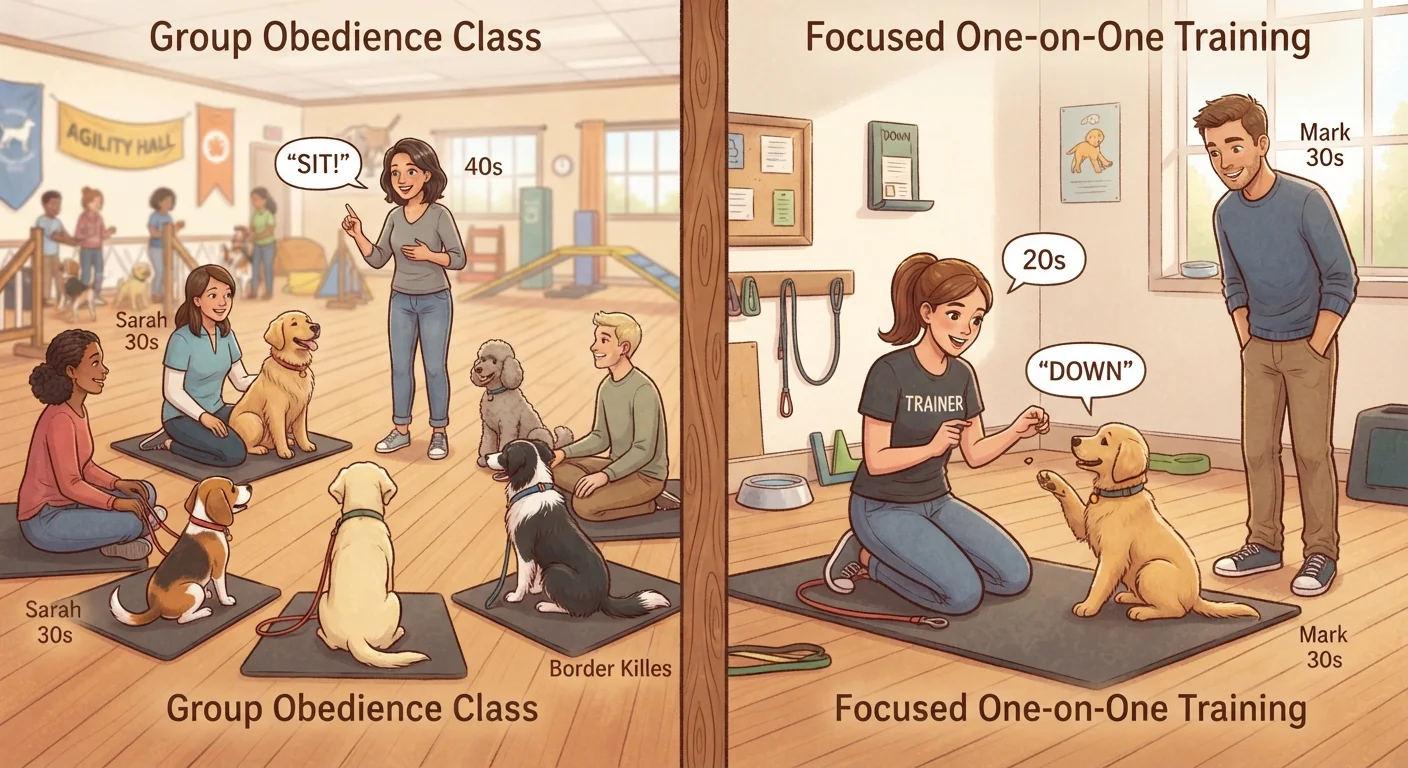
Group dog training classes typically gather four to ten dogs and their handlers in a shared space - often a pet supply store, training facility, or community center. A single certified trainer leads the session, guiding all participants through the same skills simultaneously. Sessions usually run 45-60 minutes and are organized into multi-week programs covering basic obedience, puppy manners, or specific skill sets.
Private training, sometimes called one-on-one or in-home training, pairs your dog and family with a single trainer for a dedicated session focused entirely on your situation. Sessions may take place in your home, a park, or a training facility. The trainer can observe your dog's real environment, adjust techniques in real time, and address the precise behaviors your household is struggling with.
Understanding the structural differences between these formats is the first step - but the more useful question is which one matches your dog's current needs and your family's practical realities. For a broader look at the principles underpinning both approaches, see core training principles that apply across formats.
The Case for Group Classes
Lower cost makes professional training accessible
Group classes typically cost significantly less per session than private training because trainer time is shared across multiple clients. This makes them a realistic option for budget-conscious families.
Built-in distraction practice improves real-world reliability
Dogs trained around other animals and people learn to respond to cues even when the environment is busy - a critical skill for walks, parks, and family gatherings.
Whole-family participation reinforces consistency
Group settings allow every family member to practice the same commands and handling techniques alongside the trainer, reducing the inconsistency that derails many training efforts at home.
Natural socialization opportunity for young dogs
For puppies in their socialization window (generally up to around 14-16 weeks), structured exposure to other dogs and people in a supervised setting supports healthy social development.
Peer motivation can boost engagement
Some dogs and handlers work harder in a class environment, drawing energy from the group dynamic and the mild friendly competition of learning alongside others.
Cost is the most immediate advantage. Group classes distribute the trainer's time across several clients, which significantly reduces the per-session price. For families managing a household budget, this makes professional guidance far more accessible.
Beyond cost, the group environment itself is a teaching tool. Dogs learn to focus on their handler amid distractions - other dogs, unfamiliar smells, excited children - which is exactly the real-world skill most families actually need. A dog that sits perfectly in a quiet kitchen but ignores commands at the park hasn't fully generalized the behavior.
Group classes also put the family in the room alongside the trainer, which helps everyone practice the same cues and handling techniques. Consistency across all family members is one of the biggest predictors of training success, and group classes naturally build that shared vocabulary. Involving kids in training works especially well in structured group settings where a trainer can supervise the whole family at once.
The Case for Private Training
Limited individual attention from the trainer
With multiple dogs and handlers in the room, a group trainer cannot closely monitor each pair. Subtle handling mistakes or individual learning differences may go uncorrected for an entire session.
Not suitable for reactive or fearful dogs
Dogs that become anxious, aggressive, or overwhelmed around unfamiliar dogs can be unsafe in a group setting and may have their negative associations reinforced rather than resolved.
Fixed curriculum may not match your dog's needs
Group programs follow a set syllabus designed for the average dog. If your dog already knows basic skills or has an atypical behavioral profile, the standard curriculum may offer little value.
Higher cost per session for private training
Private trainers typically charge considerably more than group classes, which can put regular sessions out of reach for families on a tight budget without careful planning.
Home sessions may miss generalization
Private in-home training is highly tailored but may not expose your dog to enough varied environments, meaning learned behaviors can fail to transfer to public spaces without additional work.
Trainer quality varies significantly across both formats
Dog training is largely unregulated in the United States, meaning credentials, methods, and experience vary widely. Vetting any trainer carefully - regardless of format - is essential.
Private sessions come into their own when a dog has specific challenges that a group setting cannot safely or effectively address. Reactive dogs - those that lunge, bark intensely, or become overwhelmed around other dogs or strangers - are poor candidates for group classes, at least initially. Putting a reactive dog in close proximity to unfamiliar dogs may actually reinforce anxious or aggressive responses rather than reduce them.
A private trainer can also assess your home environment, your daily routine, and the specific triggers that set your dog off. This context-sensitivity is something group curricula simply aren't built for. If your dog is jumping on elderly relatives, guarding the food bowl, or struggling with separation anxiety, a tailored plan will be far more effective than working through a standardized syllabus.
Families dealing with a rescued dog with an unknown history, or one that has developed entrenched problem behaviors, often find that private training is the necessary first step before group work becomes viable. For clarity on what training methods a private trainer might use, the science behind reward-based versus correction-based approaches is worth reviewing before your first session.
How to Decide - and When to Combine Both
Vetting a Trainer Before You Commit
Dog training is not federally regulated in the United States, so credentials vary widely. Look for trainers certified through recognized professional bodies such as the CCPDT or IAABC, and ask directly about the methods they use. A reputable trainer will welcome questions about their approach and explain their reasoning clearly. If a trainer resists questions or relies heavily on aversive tools, consider that a red flag.
Neither format is inherently superior. The decision should be driven by an honest assessment of your dog's temperament, your training goals, and your budget. A confident, social puppy with no behavior concerns is an excellent group class candidate. A shy, reactive, or previously traumatized dog will likely benefit more from private sessions first.
Many families find the most durable results come from sequencing: private sessions to address foundational issues or problem behaviors, followed by group classes to build generalization and socialization. Others use group classes as the primary format and add a one-off private session when a specific challenge emerges.
One practical tip: before enrolling in either format, ask trainers about their credentials and methods. Look for professional certification through recognized bodies such as the Certification Council for Professional Dog Trainers (CCPDT) or the International Association of Animal Behavior Consultants (IAABC). Also confirm that the methods align with what current behavioral science supports - understanding specific training techniques like clicker and lure training can help you evaluate what a trainer is offering. And if any approach seems to conflict with what you've heard before, separating training myths from evidence-based guidance is a useful reference.