

Key Takeaways
Why families struggle - and what actually helps
Bringing a child into pet training sounds straightforward, but most families hit the same wall: the pet listens to one person and ignores everyone else, training sessions turn into chaos, or a well-intentioned child accidentally reinforces the exact behavior the family is trying to stop. These aren't signs of failure - they're predictable outcomes when training lacks structure and age-appropriate roles.
The good news is that the core principles of effective pet training - consistency, timing, and positive reinforcement - are things families can learn together. Children who grow up involved in training often develop stronger bonds with pets and a genuine sense of responsibility. The key is building a system that accounts for where each family member actually is developmentally.
Not All Pets Respond the Same Way
Dogs and cats have different learning styles, stress thresholds, and social needs. What works well in a dog training session may be counterproductive with a cat or a small animal. Before involving children in training, understand the specific behavioral tendencies of your pet's species and, where possible, consult your veterinarian or a certified animal behaviorist for guidance tailored to your pet.
Whether you have a dog, cat, or another companion animal, the tips below are designed to help your family build reliable habits without frustration. If you're still deciding how to approach training methods overall, our ground-up introduction to dog training lays out the fundamentals clearly.
Match tasks to your child's age and ability
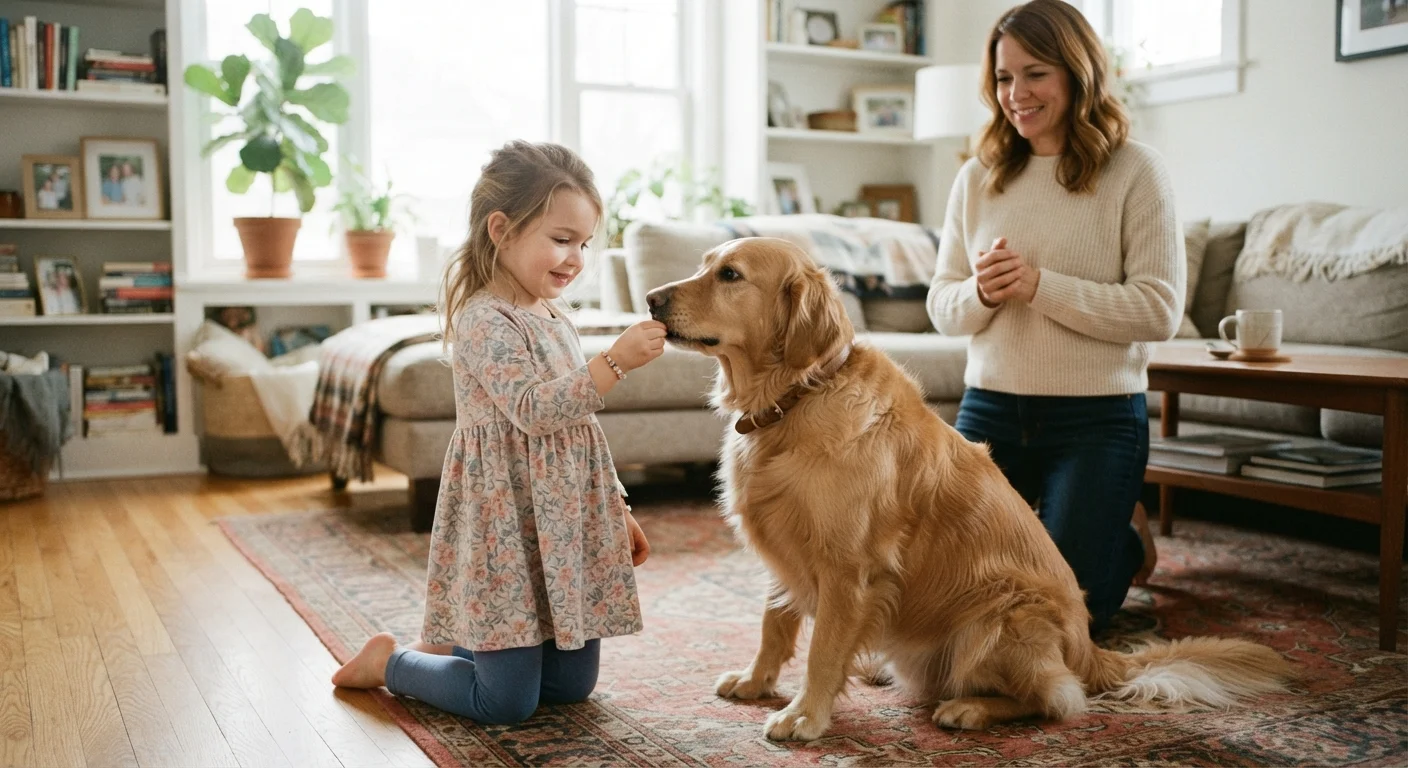
A 4-year-old cannot reliably deliver a treat at the right moment - and mistimed rewards teach pets the wrong behavior. Developmental readiness matters here. Children ages 5 to 7 can handle simple cues like "sit" when supervised by an adult. Kids 8 and older can manage basic leash work, recall practice, and short reward sequences with guidance. Teenagers can take on more independent roles, including managing training sessions with a parent nearby.
Before assigning any role, walk your child through the steps yourself and watch them practice once or twice without the pet. This prevents frustrating misfires that can confuse an animal mid-session.
Mistimed rewards teach pets the wrong behavior - match every task to your child's actual readiness.
Agree on one command set for the whole family
Pets - particularly dogs - do not generalize spoken words the way humans do. If one family member says "down" to mean "lie down" and another uses it to mean "get off the couch," the animal receives genuinely conflicting information. Hold a quick family meeting before training begins. Write the agreed commands on a small card and post it where everyone can see it.
This applies to rewards too. Decide together whether treats, praise, or toys are the primary reinforcer and stick to it. Inconsistent reward systems are one of the most common reasons family pets progress slowly. For a deeper look at how reinforcement methods differ, see our comparison of clicker, lure, and shaping techniques.
Conflicting commands from different family members are one of the fastest ways to stall a pet's progress.
Keep training sessions short and structured
Most pets - especially puppies and kittens - have short attention spans, and so do children. Aim for 3-to-5-minute sessions rather than long, ambitious ones. Two or three short sessions spread across a day outperform one 20-minute session for both learning retention and keeping kids engaged. Set a small visible timer so children understand when the session ends.
End every session on a success. If the pet is struggling with a new cue, return to something they already know well, reward it, and close there. This keeps both the animal and the child feeling positive about the next session.
Short, frequent sessions build more reliable behavior than longer, less frequent ones.
Use positive reinforcement and skip punishment-based methods
Punishment-based techniques - yelling, leash corrections, or physical reprimands - are not appropriate for children to use, and current consensus among veterinary behaviorists strongly discourages them for any family member. Beyond being less effective than reward-based training, they increase stress in animals and can create defensive behaviors that put children at risk.
Stick to reward-based methods: small food treats, enthusiastic verbal praise, or a favorite toy delivered immediately after the desired behavior. This approach is safe for children to practice, is consistent with what professional trainers recommend, and produces lasting results. Our article on training principles that apply across species covers why this works broadly.
Reward-based training is the only method appropriate for children to use - and it outperforms punishment long-term.
Supervise every child-pet training interaction
Even a well-trained, gentle pet can react unpredictably when a child moves abruptly, delivers treats erratically, or repeats a cue too many times. Adult supervision is non-negotiable during training, not just for safety, but to catch and correct training errors before they become habits.
Watch for signs that the pet is stressed - lip licking, yawning, turning away, or a tucked tail in dogs; flattened ears, tail flicking, or a crouched posture in cats. If you see these, end the session calmly and give the animal space. Teaching children to read these signals is itself a valuable lesson. For a well-behaved cat-specific perspective, cat training has its own important nuances worth understanding.
Teaching children to read a pet's stress signals is as important as teaching them the commands.
Give children meaningful but bounded roles
Children are more motivated when they have real ownership over a part of the process. Rather than making kids passive observers, assign them a defined role: the treat keeper, the one who signals the start of each session, or the person who practices one specific cue the pet already knows reliably. This keeps involvement genuine without putting them in charge of something too complex.
As the pet's skills grow, so can a child's responsibilities. Celebrate progress together as a family - this reinforces the shared effort and keeps everyone invested. If your family is still in the preparation stage, our family training readiness checklist is a helpful starting point before training begins.
A child with a real but bounded role stays engaged far longer than one who only watches.
Building a routine that sticks for the whole family
Successful family pet training isn't a single event - it's a daily practice woven into your household rhythm. Pets learn through repetition across different people and contexts, so the more consistently every family member applies the same approach, the faster and more reliably behaviors become established.
Make a Family Training Chart
A simple chart on the refrigerator listing agreed commands, reward types, and which family member leads each session can eliminate most consistency problems. Update it as your pet learns new skills. Shared ownership of the chart keeps everyone accountable - including younger children who can check off completed sessions.
As your pet progresses, revisit how roles are distributed. A skill that once required full adult management may become something an older child can handle with light supervision. Staying flexible while maintaining shared standards is what keeps training sustainable over months and years. For families managing specific challenges like leash behavior, our article on why leash pulling happens and how to address it offers practical next steps the whole family can practice on walks together.