

Key Takeaways
Our Verdict
Clicker training, lure-reward, and shaping each have genuine strengths - none is universally superior. Lure-reward gives families the fastest on-ramp for basic obedience, clicker training adds precision for more complex cues, and shaping builds problem-solving confidence in dogs who've already mastered the basics. Most experienced trainers draw on all three.
| Best for | Recommended |
|---|---|
| Families just starting out with a new dog or puppy | Lure-reward training |
| Teaching precise, complex, or duration-based behaviors | Clicker training |
| Building a dog's independent thinking and confidence | Shaping |
| Trainers comfortable mixing techniques for faster results | Combination approach |
How These Three Methods Actually Differ
Dog training terminology can get confusing fast. Clicker training, lure-reward, and shaping are all rooted in the same science - operant conditioning and positive reinforcement - but they differ in how the trainer communicates the desired behavior to the dog. Understanding those differences helps you choose the right tool for each situation.
Before diving in, it helps to understand one foundational idea: a marker is any signal that tells the dog "yes, that's exactly it" at the precise moment the correct behavior occurs. The marker bridges the gap between behavior and reward. All three methods use markers - they just use them in slightly different ways. For a broader grounding in these principles, see core training principles that apply across species.
| Clicker Training | Lure-Reward | Shaping | |
|---|---|---|---|
| How behavior is initiated | Dog acts; click marks the moment | Treat guides dog into position | Dog experiments; correct steps rewarded |
| Best for beginners | Moderate - requires coordination | Yes - very intuitive | No - requires patience and timing |
| Precision of communication | High - click is fast and consistent | Moderate - position is shown | High - built incrementally |
| Speed to first behavior | Moderate | Fast | Slow to moderate |
| Risk of dependency on food in hand | Low - marker separates treat | Higher - lure must be faded | Low - no lure used |
| Dog's mental engagement | Moderate to high | Moderate | Very high |
| Equipment needed | Clicker, treats | Treats only | Treats only |
Clicker Training: Precision in a Click
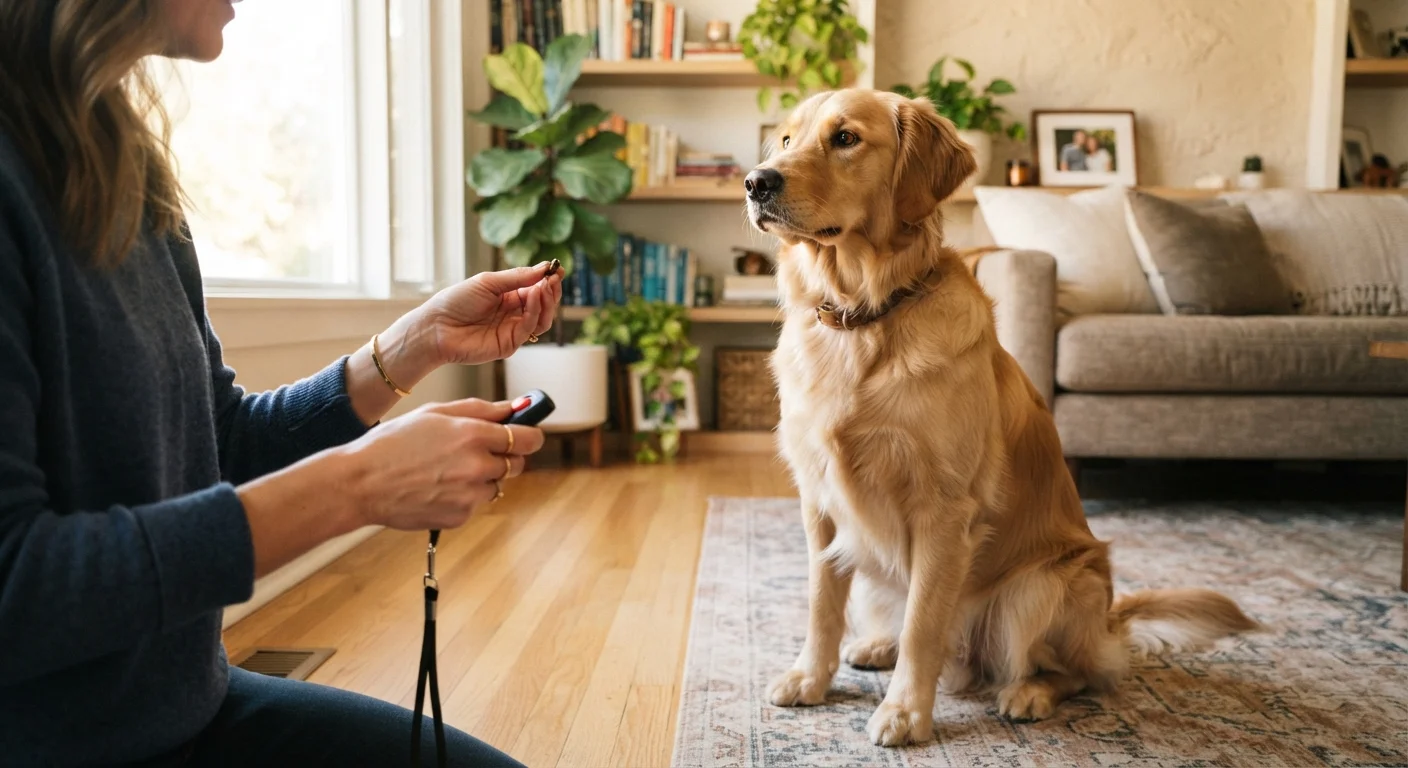
A clicker is a small handheld device that makes a short, consistent clicking sound. The trainer uses it to mark the exact instant the dog performs a correct behavior - then follows immediately with a treat. The click itself has no meaning until paired repeatedly with a reward, a process called charging the clicker.
Once the dog associates the click with incoming reward, the tool becomes remarkably precise. Because the click is faster and more consistent than a verbal "yes," it's particularly effective for shaping fine motor behaviors - a tight heel position, a solid stay, or the exact moment four paws touch a mat.
The trade-off is coordination. Holding a leash, a clicker, and treats while managing a dog takes practice. Families who feel clumsy at first often switch to a consistent verbal marker (a short, sharp word like "yes") until their timing improves. For a look at how reward-based methods compare to correction-based training, see what the science says about positive reinforcement vs. correction-based training.
Charging the Clicker Correctly
Before using a clicker to train a specific behavior, spend a few minutes simply clicking and immediately delivering a small treat - regardless of what the dog is doing. Repeat 10-20 times across one or two short sessions. Once your dog's ears perk up or they look at you expectantly at the sound of the click, the clicker is 'charged' and ready to use as a precise marker.
Lure-Reward Training: The Fastest On-Ramp
Lure-reward training uses a treat (or toy) held in the trainer's hand to guide the dog into position. A treat moved slowly over a dog's nose toward its tail produces a sit almost automatically. The reward is given the moment the dog lands in the correct position.
This method is highly intuitive, which is why most beginner classes rely on it. A child can hold a treat at nose height and get a reliable sit within minutes. It's also forgiving - if the dog doesn't follow the lure, you simply reposition and try again without any conflict.
The important step many families skip: fading the lure. If you always hold a treat in your signal hand, the dog learns to respond only when food is visible. Gradually transition to an empty hand mimicking the same motion, then reward from the other hand after the behavior happens. This builds a hand signal the dog responds to reliably - treat or no treat. Families involving children in training will find this approach easiest; see how to include kids safely in pet training for age-appropriate guidance.
Shaping: Teaching Dogs to Problem-Solve
Shaping - sometimes called "free shaping" - involves rewarding successive approximations of a target behavior, starting from whatever the dog already does naturally and building toward the finished goal. There's no lure guiding the dog's body. The dog must experiment and discover what earns the click.
For example, to teach a dog to touch a cone with its nose, a trainer might click for any glance at the cone, then for a step toward it, then for sniffing it, then for a deliberate nose touch. Each step is reinforced until the dog offers it confidently, then the criteria advance.
Shaping takes more patience than the other methods and can frustrate dogs (and owners) who aren't used to it. But the payoff is significant: dogs trained this way develop a habit of engaging actively with problems rather than waiting to be shown what to do. That initiative is valuable for advanced skills and can make common behavior problems like leash pulling easier to retrain.
If your dog seems confused or frustrated during shaping, lower your criteria temporarily - reward a step you've already mastered to rebuild momentum before advancing again.
Mixing Methods: What Actually Works at Home
Most professional trainers don't pick one method and stick to it exclusively. A common workflow: use a lure to get the behavior the first few times, switch to a clicker to sharpen the timing and precision, then use shaping to build variations and duration once the dog understands the concept.
For budget-conscious families, the great news is that all three methods cost almost nothing to implement. A clicker costs a few dollars, treats can be small pieces of the dog's regular kibble, and shaping requires only time and patience. Enrolling in a class can accelerate progress - for help weighing that decision, see group classes vs. private dog training.
It's also worth separating fact from popular belief before you begin. Many families come in carrying assumptions - like the idea that food rewards create dependent dogs - that aren't supported by evidence. See common dog training myths families still believe for a straightforward breakdown.
Whichever method you start with, consistency in timing and reward delivery matters more than which tool is in your hand. Short, frequent sessions - five to ten minutes - outperform long, irregular ones for nearly every dog.