

Key Takeaways
Why Crate Training Works
Dogs are naturally inclined to seek out small, enclosed spaces for rest and security - a trait rooted in their ancestral denning behavior. A well-introduced crate taps into that instinct, giving your dog a predictable, personal space in an otherwise unpredictable household. For families, this translates into a powerful tool for housebreaking, preventing destructive behavior, and keeping a young dog safe when no one can supervise.
Crate training is not about confinement as a consequence. It is about teaching your dog that their crate is the best seat in the house - calm, comfortable, and entirely theirs. When done correctly, many dogs voluntarily retreat to their crates for naps long after formal training is complete.
If you are brand new to owning a dog, the first-dog training guide provides a helpful foundation before you begin working with a crate.
Cover three sides of a wire crate with a blanket to create a more den-like atmosphere - many dogs settle faster in a darker, enclosed space.
Reducing visual stimulation helps dogs with high arousal levels calm down more quickly, which accelerates the association between the crate and rest.
Teach a specific crate cue word from day one and use it consistently - once learned, this verbal signal can settle your dog in any crate, anywhere, including at the vet or while traveling.
A reliably conditioned cue transfers across environments, making the trained crate response portable and genuinely useful throughout the dog's life.
Choosing the Right Crate Size and Type
Size is the single most important factor in crate selection. Your dog needs enough room to stand up fully, turn around, and lie down on their side - nothing more. An oversized crate can actually undermine housetraining because the dog may use one end as a bathroom and sleep in the other.
For growing puppies, many owners purchase an adult-sized crate and use a divider panel to reduce the interior space, expanding it as the puppy grows. This is a cost-effective approach that avoids buying multiple crates.
Crate Types at a Glance
- Wire crates: Good airflow, collapsible for storage, and most dogs adjust well to them. The open design lets dogs see their surroundings, which some find comforting and others find overstimulating.
- Plastic crates (airline-style): More den-like and enclosed, which some anxious dogs prefer. Required for air travel.
- Soft-sided crates: Lightweight and portable, but not suitable for dogs who chew or scratch at the walls.
Place the crate in a family common area - a living room or bedroom corner - rather than an isolated room. Dogs are social animals, and isolation increases stress.
~4 hrs
Max crate time for a 3-month-old puppy
Veterinary behaviorists generally recommend one hour of bladder control per month of age, plus one, as a practical maximum.
18 mo
Typical age before full household freedom
Many certified trainers recommend waiting until a dog is at least 18 months old and consistently reliable before allowing unsupervised access to the whole home.
Introducing the Crate: Days One Through Seven
The first week of crate training sets the tone for everything that follows. Move slowly and let your dog's comfort level guide the pace.
Step 1: Make it Inviting
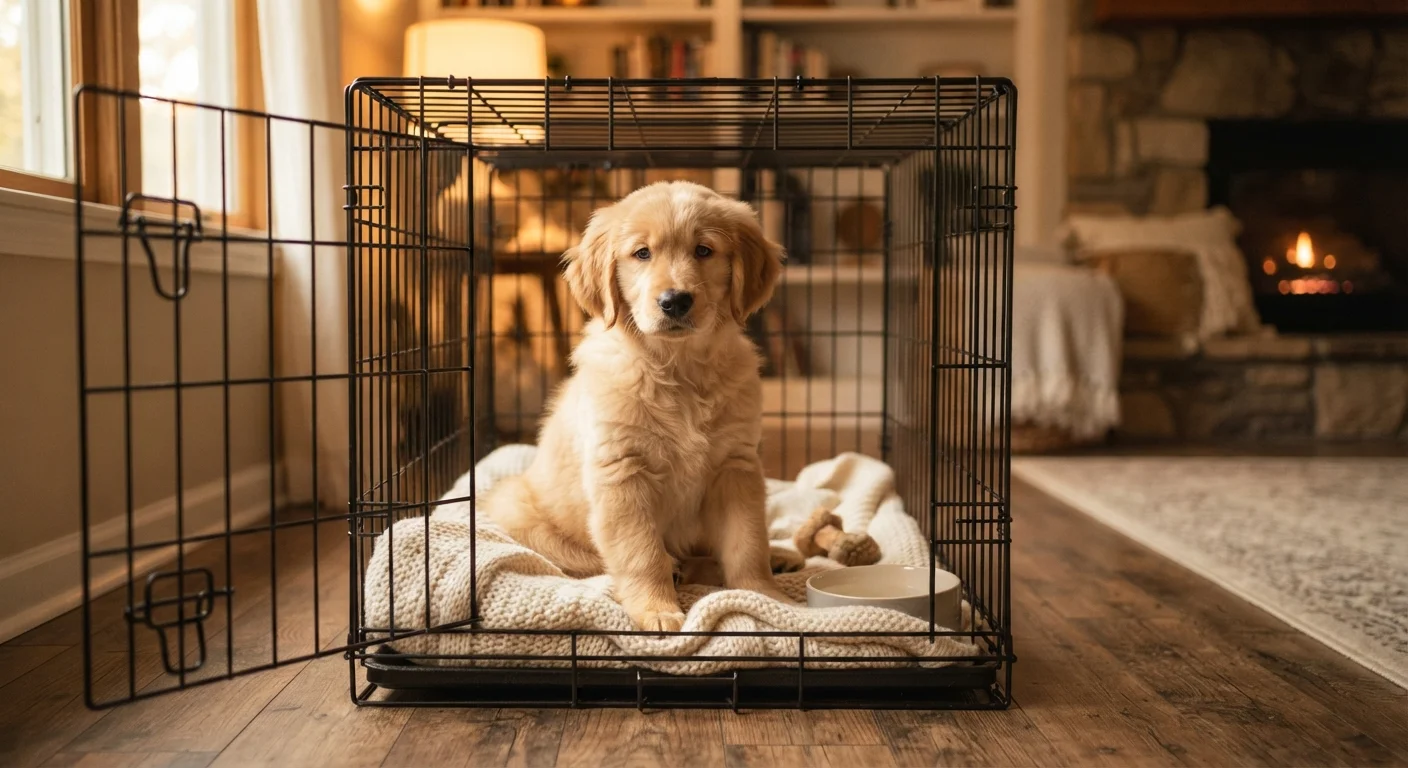
Place the crate in your living area with the door propped open. Put a soft blanket inside and drop a few treats just inside the entrance. Do not push your dog in. Let them investigate freely and reward any voluntary approach with quiet praise.
Step 2: Feed Meals Near, Then Inside, the Crate
Begin feeding your dog's regular meals near the crate entrance, then gradually move the bowl further inside over several sessions. Once your dog eats comfortably with the bowl at the back of the crate, start closing the door briefly during meals and reopening it as soon as they finish.
Step 3: Short Stays with You Present
Cue your dog into the crate using a consistent word like crate or place, reward them inside, and close the door for two to five minutes while you sit nearby. Gradually increase this to ten minutes before leaving the room. This teaches the dog that the door closing is not alarming.
For families with children, the guide on training with kids explains how to involve children without disrupting this early conditioning.
Building Up to Longer Stays
Once your dog settles calmly for ten to fifteen minutes with you out of the room, you are ready to extend duration. Increase crate time in fifteen-minute increments, working toward one to two hours over the course of a week or two.
Never Exceed Safe Crating Durations
Keeping a dog crated longer than their age and bladder capacity allow causes physical discomfort and can create lasting negative associations with the crate. Adult dogs should generally not be crated for more than four to five hours during the day without a break. If your work schedule requires longer absences, arrange for a midday dog walker or family member to provide relief.
A general guideline from veterinary behaviorists is that puppies can hold their bladder for roughly one hour per month of age, plus one - so a three-month-old puppy needs a bathroom break after about four hours at most. Plan your schedule accordingly and never exceed this limit.
Always give your dog a bathroom opportunity and a short walk before crating for a longer period. A dog who has burned off some energy and relieved themselves will settle far more readily than one who hasn't. You can pair a food-stuffed chew toy (such as a frozen, treat-filled rubber toy) with the crate to give your dog a positive activity during the first few minutes of confinement.
Separation-related distress is a separate concern from ordinary crate reluctance. If your dog is panicking, vocalizing intensely, or injuring themselves trying to escape, consult your veterinarian or a certified applied animal behaviorist before continuing. The guide to helping puppies stay alone addresses this specific challenge in detail.
Common Mistakes and How to Avoid Them
Even well-intentioned owners fall into predictable traps. Knowing them in advance saves weeks of backtracking.
- Using the crate as punishment. If the crate becomes associated with scolding or timeout, your dog will resist it. Never send your dog to the crate in anger.
- Moving too fast. Skipping steps or extending duration before the dog is ready creates anxiety. Each step should be comfortable before advancing.
- Letting the dog out while barking. If you open the crate door in response to barking, you teach the dog that barking is the exit strategy. Wait for a pause in vocalizing, even a brief one, before opening the door.
- Crating for too long, too often. A crate is not a substitute for exercise, play, or training. Dogs left crated for most of the day are at risk for behavioral and physical problems.
Understanding the broader landscape of training approaches can help you reinforce crate manners consistently. See our comparison of clicker, lure, and shaping methods for context on how rewards-based techniques apply here.
When to Phase Out the Crate
There is no universal timeline for when a dog no longer needs a crate. Some dogs appreciate their crate their entire lives as a personal retreat. Others can be gradually trusted with more household freedom once they have demonstrated reliable housetraining and no destructive tendencies when unsupervised.
A practical approach is to begin leaving your dog loose in a single, dog-proofed room for short periods while you are home. If no accidents or destruction occur over several weeks, expand their access room by room. Many trainers recommend waiting until a dog is at least eighteen months old and has been reliably trained before granting full household freedom during absences.
Before your new pet arrives, having your crate setup and family routine planned is essential. The family training readiness checklist can help you prepare everything before day one.
This article provides general educational information about dog training and is not a substitute for guidance from a qualified veterinarian or certified animal behaviorist. If your dog shows signs of distress, fear, or anxiety related to confinement, consult a professional before continuing.